Key facts
- Type
- Competition
- Provider
- Volume Zero
- Deadline
- 12/3/2026
In short
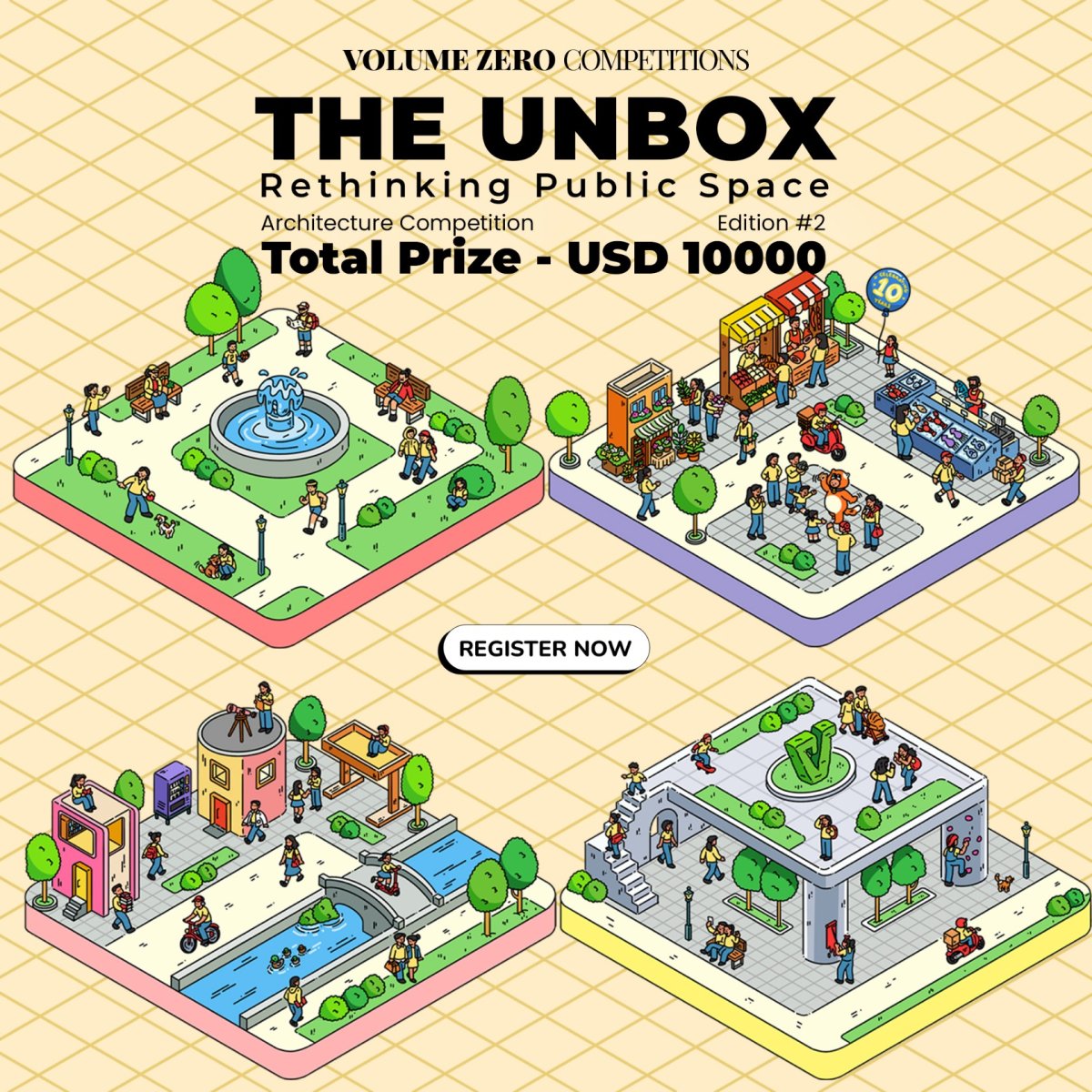
Unbox 2026 is an international architecture competition by Volume Zero challenging designers worldwide to create micro-architectural public spaces for a chance to win a share of $10,000.
Call For Ideas: Unbox 2026 Architecture Competition
By Volume Zero
CompetitionAccepting applications nowApply by 12/3/202679 days left
$10,000
Total prizes
Micro public space
Challenge focus
3000 sq ft (278 sq m)
Maximum built-up area
Worldwide
Eligibility
December 3, 2026
Submission deadline
Overview
The Unbox 2026 competition celebrates Volume Zero's 10th anniversary by calling for innovative micro-architectural solutions that redefine public spaces. In an era marked by digital isolation and environmental changes, the competition emphasizes the critical role of communal spaces. It invites global designers to move beyond traditional large-scale civic infrastructure and "think small" to achieve significant impact through nimble, inclusive, and multifunctional designs. The challenge is to design a micro public space, with a maximum built-up area of 3000 square feet (278 square meters), capable of accommodating at least 250 users daily. The proposed design must support a minimum of three distinct uses across daily or seasonal cycles. Submissions can take various forms, including pavilions, small public buildings, hybrid landscape-architecture interventions, modular systems, or deployable structures. Participants are free to select any site globally, from urban centers to remote landscapes, but must clearly identify and justify their chosen location. Entries will be evaluated on their considered response to the social, cultural, and environmental conditions of the site. Proposals need to articulate the community served, the local need addressed, and how the design engages with its context. Site sensitivity and contextual awareness are fundamental judging criteria. This competition aims to prove that even small interventions can serve as powerful prototypes for a more democratic and resilient future, encouraging designers to reimagine the pulse of cities.
What to build
Participants are invited to design a micro public space with a maximum built-up area of 3000 square feet (278 square meters), designed to accommodate a minimum of 250 users per day. The proposal must support at least three distinct uses across daily or seasonal cycles. It may take the form of a pavilion, a small public building, a hybrid landscape-architecture intervention, a modular system, or a deployable structure. Participants may select a site anywhere in the world, which must be clearly identified and justified. Entries should demonstrate a considered response to the social, cultural, and environmental conditions of the site.
Prizes
1st Prize
USD 5000
2nd Prize
USD 2500
3rd Prize
USD 1500
Gold Mention
USD 1000
Key dates
- Headstart Registrations5th March 2026 to 10th July 2026
- Early Bird Registration11th July 2026 to 11th September 2026
- Standard Registration12th September 2026 to 6th November 2026
- Closing date for Submissions3rd December 2026
- Announcement of winners5th February 2027
Eligibility
The competition is open to everyone worldwide.
How to enter
- Register for the competition during one of the registration periods (Headstart, Early Bird, or Standard).
- Pay the applicable registration fee based on your country of origin.
- Submit your proposal by the closing date for submissions.
Submission requirements
- Design a micro public space with a maximum built-up area of 3000 square feet (278 square meters).
- The design must accommodate a minimum of 250 users per day.
- The proposal must support at least three distinct uses across daily or seasonal cycles.
- Clearly identify and justify the chosen site location anywhere in the world.
- Articulate who the space serves, what local need it addresses, and how the proposal engages with its context.
Judging criteria
- Considered response to the social, cultural, and environmental conditions of the site.
- Site sensitivity and contextual awareness.