Artificial Intelligence in Netherlands
12 Artificial Intelligence programmes are offered across 9 universities in the Netherlands, making it one of the more competitive AI study destinations in Europe. Institutions represented include Eindhoven University of Technology, Universiteit Leiden, Erasmus University Rotterdam, Hogeschool van Amsterdam, and the International Institute for Geo-Information Science and Earth Observation. Tuition varies by programme — check each listing for the exact fee.
Dutch AI programmes typically cover machine learning, data engineering, computer vision, and natural language processing, and most are fully English-taught. EU/EEA students generally pay lower tuition rates than non-EU students; international applicants should verify the applicable fee schedule directly with each institution before applying.
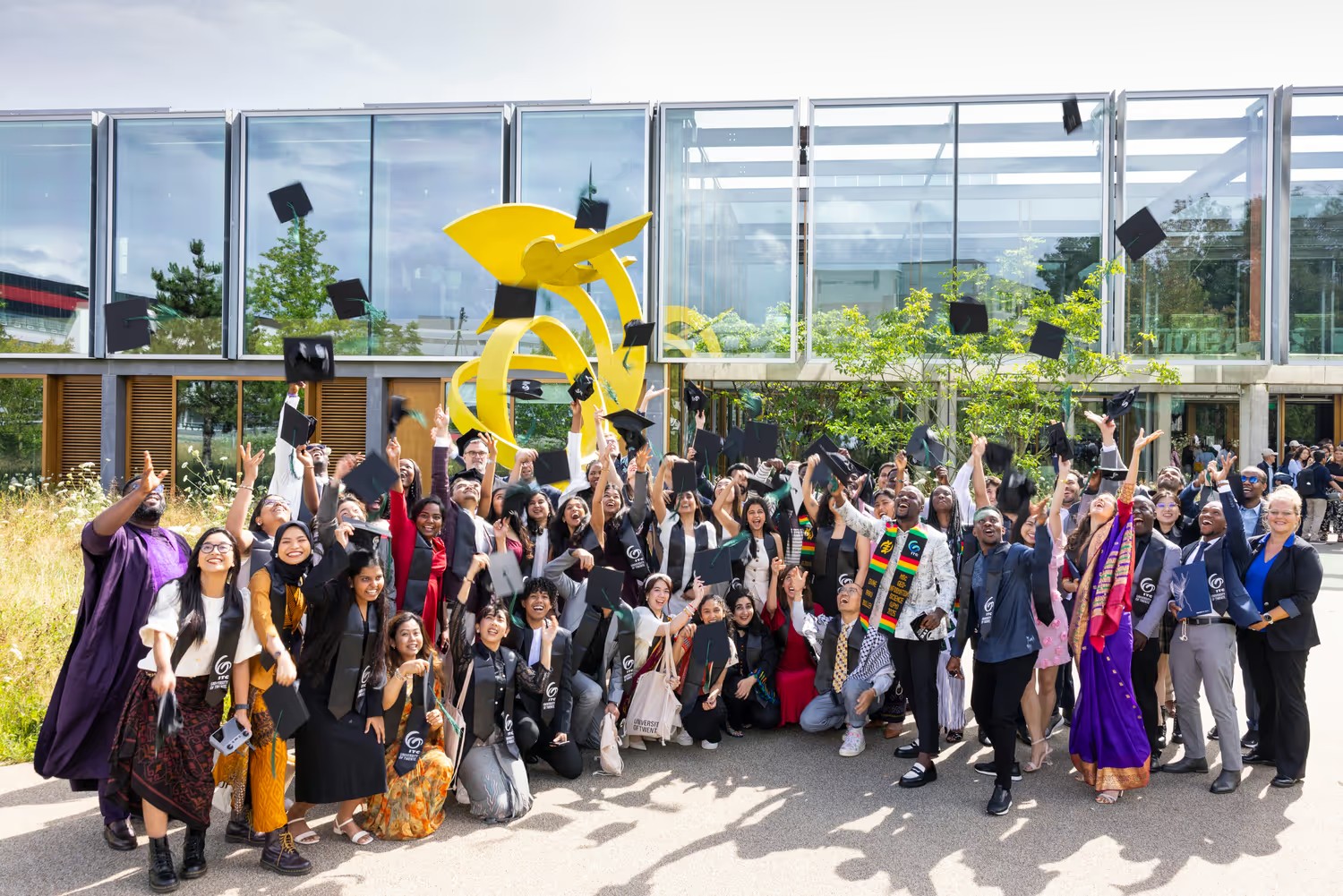
A Survey of Active Learning for Quantifying Vegetation Traits from Terrestrial Earth Observation Data
This study explores the use of Active Learning (AL) techniques to improve the analysis of Earth Observation (EO) data for monitoring vegetation. As satellite data streams increase, efficient methods are needed to translate this data into useful information about vegetation properties. The research focuses on hybrid retrieval approaches, which combine physical models (Radiative Transfer Models) with machine learning algorithms. AL can help by intelligently selecting the most informative data samples for training these algorithms. The paper summarizes AL theory, reviews its application in EO, and presents a case study demonstrating how AL can enhance the accuracy and speed of estimating vegetation traits like leaf pigment and water content. The findings suggest that AL-based sampling is a valuable method for optimizing regression accuracy, reducing processing time, and facilitating data analysis for vegetation monitoring.

Applied AI
The Applied AI program focuses on the practical and responsible application of Artificial Intelligence (AI) in various fields. Rather than developing new AI technologies, the program emphasizes using AI as a tool to create meaningful solutions. Through co-creation with educational institutions, researchers, businesses, and civil society, the program aims to design, develop, and implement AI applications that benefit companies and communities.

Applied Data Science & Artificial Intelligence (ADSAI)
This Bachelor's program focuses on Applied Data Science and Artificial Intelligence (ADSAI), combining technical skills in data and algorithms with an understanding of AI's societal impact. You'll learn to design intelligent systems, explore the ethical considerations of AI, and understand the interactions between humans and machines. The program is ideal for those who want to merge engineering principles with the human aspects of technology, preparing you for an international working environment as it is taught entirely in English.

Artificial Intelligence
This Bachelor's program in Artificial Intelligence focuses on understanding and simulating the human brain to create smarter computers and robots. It's an interdisciplinary field that combines insights from human cognition, psychology, neuroscience, logic, linguistics, mathematics, and computer science. You'll learn how the human brain works to better model artificial intelligence, and conversely, use computer models to understand the human brain. Programming is taught from the beginning at a manageable pace. The program offers opportunities to personalize your studies through elective courses and potentially complete part of your degree abroad. You'll be supported by a dedicated student mentor in your first year.

Artificial Intelligence
The Master's programme in Artificial Intelligence at the University of Amsterdam offers a deep academic understanding of AI and its real-world applications. This program is designed for students who want to become experts in the rapidly evolving field of AI, covering topics such as machine learning, natural language processing, and deep learning. You will engage with both technical and scientific approaches to AI research, learning from world-renowned researchers and experts in an international and informal teaching environment.
Artificial Intelligence (MSc)
This master's specialisation in Artificial Intelligence focuses on future-oriented topics within computer science, with a strong emphasis on machine learning, optimization algorithms, and decision support techniques. You will explore the capabilities of advanced Artificial Intelligence algorithms, learning how computers can learn from data with minimal human intervention once programmed. The program delves into extracting knowledge from complex data and finding optimal solutions for various processes.

Digital and AI Strategy
This intensive three-day workshop is designed for professionals seeking to enhance their strategic advisory skills in the rapidly evolving digital landscape. You will learn to recognize the strategic implications of emerging digital technologies like AI, IoT, and blockchain, and understand their impact on various business functions. The course will guide you in managing digital ecosystems, identifying challenges, and turning disruption into opportunities. By the end of this program, you will be equipped to anticipate digital trends, formulate effective strategic responses, and drive the implementation of digital strategies within your organization, ultimately creating new value propositions and improving customer journeys.
Global daily 9km remotely sensed soil moisture (2015-2025) with microwave radiative transfer-guided learning
This research presents a global dataset of daily soil moisture at a 9km resolution, covering the period from 2015 to 2025. The dataset was generated using a novel approach that combines microwave radiative transfer modeling with machine learning techniques. This method aims to improve the accuracy of soil moisture estimation, which is crucial for understanding terrestrial ecosystems and their responses to environmental changes. The generated data provides a valuable resource for researchers studying climate, hydrology, agriculture, and environmental management. By offering a consistent and high-resolution view of soil moisture across the globe, this dataset can support a wide range of applications, from drought monitoring to crop yield prediction and carbon cycle studies.
Master Artificial Intelligence (MSc)

Master Artificial Intelligence and Engineering Systems
The Master's program in Artificial Intelligence and Engineering Systems (AI&ES) at Eindhoven University of Technology (TU/e) focuses on the intersection of advanced AI techniques and robust engineering principles. This program is designed for students who are passionate about using AI to innovate and improve engineering systems across various industries. You will gain a comprehensive understanding of machine learning, data-driven decision-making, human-AI interaction, and core engineering concepts, preparing you to develop real-world AI applications. Located in the heart of the Netherlands' tech hub, Brainport Eindhoven, TU/e offers strong connections with industry and research institutions. This program specifically bridges the gap between cutting-edge AI research and its practical application in the semiconductor industry and other technological fields, preparing you for careers in areas like neuromorphic computing and brain-inspired semiconductors. The AI&ES program is a highly interdisciplinary effort, involving seven departments at TU/e. This collaborative approach ensures a well-rounded education that integrates AI, data science, programming, ethics, and human interaction, making graduates highly sought after in diverse sectors.
Master Data Science and Artificial Intelligence
This Master's program in Data Science and Artificial Intelligence (DS&AI) is designed to equip you with the skills to analyze large datasets and develop intelligent systems. It combines advanced techniques from both data science and artificial intelligence, offering a unique interdisciplinary approach. The program focuses on developing engineers who are not only technically excellent but also socially responsible, aiming to create human-centered, trustworthy, and sustainable solutions. You will gain expertise in areas like process mining, visualization, and knowledge management, preparing you to address significant societal and industrial challenges.
MBA in Applied Artificial Intelligence
The MBA in Applied Artificial Intelligence is a specialized Master of Business Administration program designed for individuals with a background in science and technology who are seeking to understand and lead in the rapidly evolving field of AI. This program is taught entirely in English and aims to equip you with the knowledge and skills to manage AI-driven business operations, improve efficiency, and drive profitability. The curriculum combines foundational management principles with a deep dive into AI theory, tools, and techniques. Through case studies, guest lectures, and practical projects, you will gain insights into machine learning, natural language processing, computer vision, and their applications in business. The program emphasizes interactive learning and aims to prepare you for leadership roles at the forefront of technological development. Wittenborg University of Applied Sciences offers this program with multiple entry points throughout the year, fostering a dynamic, international, and diverse learning environment. The program is structured in intensive blocks, allowing for focused study on two modules every six weeks. This approach ensures that you can integrate your learning effectively and apply it to real-world business challenges.
Frequently asked questions
How many Artificial Intelligence programmes are available in Netherlands?
+
There are 12 Artificial Intelligence programmes listed across 9 universities in Netherlands.
Which universities in Netherlands offer Artificial Intelligence programmes?
+
Universities offering Artificial Intelligence programmes in Netherlands include Erasmus University Rotterdam, Zuyd University, International Institute for Geo - Information Science and Earth Observation, Eindhoven University of Technology, among others.
How much does it cost to study Artificial Intelligence in Netherlands?
+
Tuition varies by programme — check each listing for the exact fee.
Can international students apply to Artificial Intelligence programmes in Netherlands?
+
Yes, international students are generally eligible to apply. Requirements vary by institution — check each programme page for language proficiency standards, entry qualifications, and any country-specific admissions conditions.
What are the typical entry requirements for Artificial Intelligence programmes in Netherlands?
+
Entry requirements vary by programme and level. Most master's programmes expect a relevant bachelor's degree; bachelor's programmes typically require secondary school qualifications in related subjects. Evidence of language proficiency (e.g. IELTS or TOEFL) is usually required for English-taught programmes.