Master's in Environmental Sciences in Netherlands
There are 4 master's Environmental Sciences programmes for international students across 4 universities in Netherlands. Browse the full list below, compare entry requirements, and explore scholarships to fund your studies.
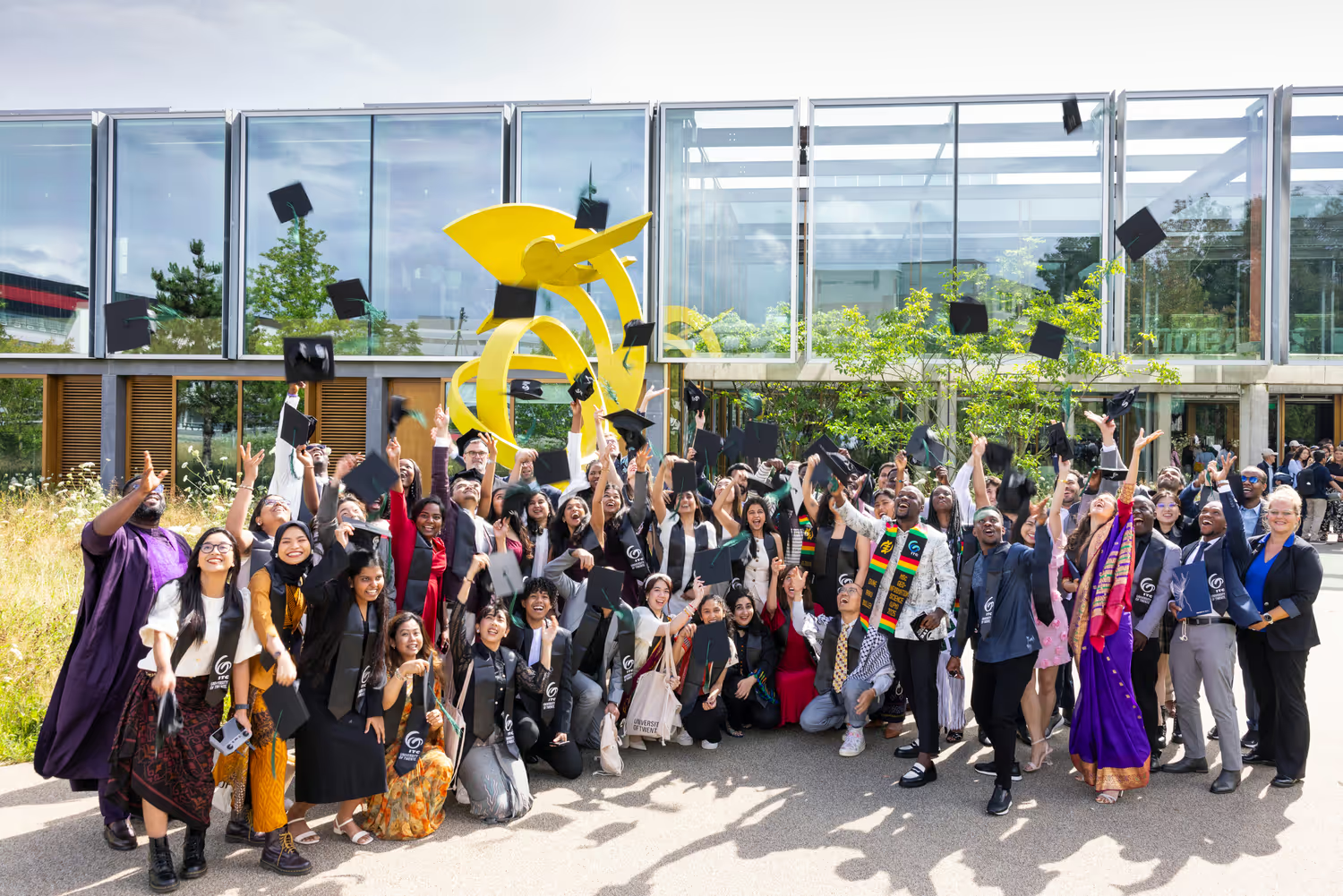
Geo-Information Science and Earth Observation (ITC) MSc Program
This Master of Science program focuses on the application of Geo-Information Science and Earth Observation technologies for understanding and managing the Earth's resources and environment. You will gain expertise in acquiring, processing, analyzing, and interpreting spatial data from various sources, including satellite imagery, aerial photography, and ground-based sensors. The program equips you with the skills to address complex challenges in areas such as environmental monitoring, urban planning, natural resource management, and disaster risk reduction. Through a blend of theoretical knowledge and practical application, you will learn to utilize advanced geospatial tools and techniques. The curriculum emphasizes critical thinking and problem-solving, preparing you to contribute to sustainable development and informed decision-making in a data-driven world. This program is designed for students passionate about leveraging technology to explore and manage our planet.

Master Duurzaamheidstransities (Master of Sustainability Transitions)
The Master of Sustainability Transitions is designed for professionals passionate about driving real-world change in areas like the energy transition and building sustainable food systems. This program equips you with the skills to initiate, guide, and accelerate transition processes at various levels, from local communities to entire systems. It's a collaborative effort between Hogeschool van Amsterdam (HvA), Hanze University of Applied Sciences Groningen, and Inholland University of Applied Sciences, pooling expertise and practical experience. The curriculum is highly practice-oriented, focusing on current societal challenges. You will develop a deep understanding of transition theories and systemic thinking. From day one, you'll engage with real-world transition issues, collaborating with research groups, governments, businesses, and community organizations. This hands-on approach allows you to research while actively intervening, designing and testing solutions directly in practice. You'll develop broad transdisciplinary skills, learning to navigate diverse interests and work across different scales, while also deepening your expertise in a specific transition theme.
Master of Science in Geo-Information Science and Earth Observation
The Master of Science in Geo-Information Science and Earth Observation is a two-year program focused on utilizing advanced spatial technologies to address global challenges. The program emphasizes the integration of Earth Observation data with other geospatial information to understand and manage environmental and societal issues, particularly within urban environments. It aims to equip students with the skills to analyze complex spatial data for informed decision-making in areas like climate change, urban planning, and resource management.
Master's Programme Geo-information Science and Earth Observation
This Master's programme in Geo-information Science and Earth Observation equips students with advanced knowledge and skills in collecting, processing, analysing, and managing geographic data. The programme focuses on applying these skills to understand and address critical global challenges related to Earth sciences and environmental management. It offers a strong academic orientation and a distinctive international focus, with opportunities for joint education programmes with international partner institutions. The curriculum provides a comprehensive understanding of geo-information technologies and their applications. Students can choose from various specialisations, allowing them to tailor their studies to specific interests within the broad field of geo-information science and earth observation. The programme aims to prepare graduates for impactful careers in research, government, and the private sector, contributing to sustainable development and informed decision-making.
MSc Urban Climate and Sustainability
The MSc Urban Climate and Sustainability program focuses on understanding and addressing the complex interactions between urban environments and climate change. It equips students with the knowledge and skills to develop strategies for more sustainable and resilient cities. The curriculum covers key aspects of urban climatology, environmental management, and sustainable development, preparing graduates for impactful careers in this critical field.
Online Master Sustainability Management
Remote Sensing Techniques for Hydrocarbon Micro-Seepage Detection in Raman Mountain, Turkey
This study investigates the effectiveness of remote sensing (RS) techniques, specifically band ratio (BR) and principal component analysis (PCA), for detecting hydrocarbon micro-seepage in the Raman Mountain area of Turkey. Traditional methods for oil and gas exploration can be time-consuming and costly. RS offers a more efficient alternative, especially in inaccessible terrains. The research utilized Landsat-8 multi-spectral data to identify surface manifestations of hydrocarbon-induced soils and sediments, focusing on areas with heavy oil characteristics (low API gravity and low permeability). The analysis identified areas rich in clay and ferrous iron, which are indicators of hydrocarbon presence. These findings were correlated with existing well data, showing a significant connection between the identified surface anomalies and hydrocarbon deposits. The study successfully demonstrated that RS techniques can reliably detect micro-seepage, even in challenging geological conditions where conventional methods might struggle. This approach supports the integration of RS into hydrocarbon exploration strategies for cost savings and improved efficiency.
Research Centre for Built Environment NoorderRuimte
The Research Centre for Built Environment NoorderRuimte is dedicated to practice-based research focused on the built environment in the Northern Netherlands. Our work is structured around four key themes: Earthquakes, Sustainability, Health & Well-being, and Liveability. We are driven by a shared passion for improving the design of our living spaces for people. Our research environment fosters collaboration among professors of applied sciences, researchers, students, and industry professionals, all working together to address current, real-world challenges in the built environment. In recognition of our commitment to excellence, NoorderRuimte Knowledge Centre was awarded the designation 'excellent' for the second consecutive time during the national assessment in 2025. We bring together expertise across multiple professorships, including Structural Safety & Earthquakes, Sustainable Built Environment, Climate Adaptation, Living Environment in Transition, Facility Management, Healthy Cities, and Real Estate.
Social Protection and Climate Change
Understanding how governance emerges in social-ecological systems: Insights from archetype analysis
This research explores the emergence of governance within social-ecological systems (SESs). It emphasizes that governance arises from the internal dynamics and interdependencies of these systems, rather than being solely an external intervention. By analyzing 60 case studies of irrigation systems in Asia, the study identifies four archetypes of governance: egalitarian, individualist, hierarchical, and fatalist. These archetypes are based on the interplay of social-ecological and infrastructural attributes within the systems. The research provides insights into how specific configurations of attributes lead to different governance outcomes. It also highlights how various social and environmental changes can disrupt the fine-tuning of these attributes. Ultimately, this work aims to contribute to complexity theory by applying concepts of emergence to SESs, offering practical guidance for achieving sustainability.
Frequently asked questions
How many Environmental Sciences programmes are there in Netherlands?
+
4 across 4 universities, listed on this page.
Can international students apply?
+
Yes — these programmes admit international students; check each programme's entry requirements and language of instruction.