DENMARK · AALBORG, ESBJERG, COPENHAGEN
Aalborg University
public · Founded 1974 · Languages: en, da
In short
Aalborg University, founded in 1974, is a Danish public research university known globally for its problem- and project-based learning (PBL) approach and operates across three campuses in Denmark.
Key facts
- Type
- Public
- Founded
- 1974
- Students
- 20,353
- International students
- 3,500
- Tuition (intl)
- €8–15k/yr
- Languages
- EN, DA
- Location
- Aalborg, Esbjerg, Copenhagen, Denmark
Aalborg University (AAU) is a Danish public research university founded in 1974, internationally recognized for its pioneering problem- and project-based learning (PBL) pedagogy. The UNESCO Chair in PBL in Engineering Education — the only such chair in the world — is hosted at AAU, affirming its global influence on educational innovation. Students work in collaborative groups on real-world problems from their first semester, developing the analytical and teamwork skills most valued by employers. AAU operates faculties covering engineering and science, social sciences and humanities, and medicine across campuses in Aalborg, Esbjerg, and Copenhagen. Its research community of over 2,300 researchers is internationally recognized in energy systems, digital technologies, computer vision, and health sciences. The university generates significant annual research output and maintains strong industry collaboration. With numerous English-taught master's and PhD programs, AAU actively welcomes international students and researchers. Student life is characterized by informal faculty-student relationships, active student associations, and the vibrant social culture of all three Danish campus cities.
Why study here
- Home of the world-unique UNESCO Chair in Problem- and Project-Based Learning (PBL).
- Real-world, collaborative learning model that employers across Europe actively seek.
- EU/EEA students study tuition-free; scholarship options for non-EU students.
- Strong research environment, especially in energy, digital tech, and health sciences.
- Study across three Danish campuses — each offering a distinct city and social experience.
Student life
Aalborg University offers a lively and supportive student environment across its campuses. The core of student life revolves around problem-based group work, which helps students build strong networks from the very beginning of their studies. Beyond academics, there are numerous student associations and activities catering to diverse interests, from sports and case competitions to music events, improvisation clubs, and NGOs like I-Life that help international students integrate into Danish culture. Campuses feature modern facilities including libraries, canteens, group study rooms, and social spaces like fredagsbarer (Friday bars), pool tables, and table tennis.
Fees
InternationalNon-EU/EEA international students pay approximately DKK 60,000–125,000 (~EUR 8,000–17,000) per year, depending on the program.
HomeEU/EEA students and Danish students attend tuition-free under the Danish higher education system.
LivingStudents should budget approximately DKK 8,000–10,000 (~EUR 1,075–1,340) per month for housing, food, and personal expenses. Aalborg is one of Denmark's more affordable cities.
Scholarship opportunities exist for non-EU/EEA students, including the Danish Government Scholarships. Tuition fees vary by faculty and program level.
Admissions
Qualifying DegreeBachelor's degree or equivalent for master's programs
TranscriptsOfficial academic transcripts from all previous institutions
Motivation LetterRequired for most master's programs
CVRequired for most master's programs
Application DeadlineMarch 1 (some programs); July 5 for others — check individual program pages
IELTS Academic6.5 overall for English-taught programs
TOEFL iBT83 overall for English-taught programs
Rankings
QS World University Rankings 2025306
THE World University Rankings 2025401–500
AAU Energy Research (EU)Among Europe's best
University scholarships
Danish Government Scholarships (Erasmus+)Full or partial tuition waiver for eligible non-EU students
AAU Talent ScholarshipPartial tuition reduction for outstanding non-EU applicants
Accreditation
Aalborg University is accredited by the Danish Accreditation Institution (AKKR) and is a full member of the European University Association (EUA). It hosts the UNESCO Chair in PBL in Engineering Education.
Programs
a selectionAalborg University · Denmark
Applied Industrial Electronics
The Bachelor's programme in Applied Industrial Electronics at Aalborg University (AAU) Esbjerg focuses on developing technologies for automating and controlling industrial processes and autonomous systems like drones. You will gain skills in designing and controlling robots and creating electronic solutions for various industries. This 3-year, English-taught programme offers a hands-on approach, preparing you for a career as an electronics engineer. This programme is designed to equip you with the knowledge and practical skills needed to develop electronic components and control industrial processes, from managing autonomous underwater robots to designing battery storage systems for solar cells. You will learn the theoretical foundations of these technologies and apply them to solve real-world industrial problems through a unique problem-based learning approach.
Bachelor's
Level
Free
Tuition
36 mo
Duration
Aalborg University · Denmark
Architecture and Design
The Bachelor's programme in Architecture and Design at Aalborg University combines design, creativity, and engineering knowledge. This unique blend equips you to develop a wide range of solutions, from modern product design to sustainable urban districts, buildings, and public spaces of the future. The programme emphasizes problem-based project work in groups, fostering close collaboration with fellow students and guidance from experienced faculty. Your studies will be primarily conducted on campus in Aalborg. Throughout the three-year programme, you will learn to integrate form and aesthetics with technology and technical expertise. You will gain insight into circular design principles applicable to both buildings and everyday products, and explore how to design everything from energy-efficient homes to digital systems. The curriculum is internationally oriented, offering opportunities for study trips to experience diverse architectural and design cultures. Early specialization allows you to deepen your skills in either Architecture and Urban Design or Industrial Design, enhancing your career prospects both in Denmark and abroad.
Bachelor's
Level
—
Tuition
36 mo
Duration
Aalborg University · Denmark
Biology
The Bachelor's programme in Biology at Aalborg University teaches you how all living things are connected, from tiny molecules and cells to vast forests and entire oceans. You will engage in both laboratory and field work, conducting experiments and observations to explore the fascinating aspects of nature. The curriculum covers a wide range of topics, including genetics, evolution, physiology, botany, and ecology. Through a problem-based learning approach, you will develop practical skills in understanding and solving biological challenges, often in collaboration with researchers and external partners.
Bachelor's
Level
—
Tuition
36 mo
Duration
Aalborg University · Denmark
Bioteknologi
The Bachelor's degree in Biotechnology at Aalborg University equips you with knowledge on how biological systems and living organisms can create or modify products and processes. This program combines biology, chemistry, and engineering, preparing you to tackle challenges in health, bioenergy, environmental sustainability, and resource utilization. You will learn to apply biological, chemical, and engineering methods, gaining practical experience in microbiology, molecular biology, and biochemistry. The curriculum emphasizes designing and conducting experiments, for instance, to understand enzyme catalysis or utilize chemical and biological processes for innovative biotechnological solutions.
Bachelor's
Level
—
Tuition
36 mo
Duration
Aalborg University · Denmark
Building and Construction Engineering, Diploma Engineer
The Diploma Engineer in Building and Construction Engineering program at Aalborg University focuses on the planning, design, and dimensioning of load-bearing structures in buildings and infrastructure. This specialization is chosen in the third year of your studies, allowing you to explore the field during your first two years. You will gain practical experience through a mandatory internship, preparing you for a career in the construction industry. The program provides a comprehensive understanding of structural elements, considering various loads from weather, wind, and fire. You will learn to propose solutions for building structures and foundations based on architectural designs. The curriculum combines theoretical knowledge with real-world applications, ensuring graduates are well-equipped for professional practice.
Diploma
Level
Free
Tuition
42 mo
Duration
Aalborg University · Denmark
Building Energy Design
The Master's in Building Energy Design at Aalborg University focuses on creating energy-efficient buildings with comfortable indoor climates. This program will equip you with the knowledge and skills to design sustainable building solutions, integrating technical expertise with energy efficiency and user comfort. You will contribute to the green transition by learning to optimize building energy consumption and apply renewable energy solutions. This two-year Master of Science (MSc) in Technology program is ideal for students with a background in construction or mechanical engineering who wish to specialize in the energy aspects of buildings. It addresses the urgent need for professionals in sustainable construction, particularly in light of ambitious goals to reduce energy requirements in existing buildings and integrate sustainable solutions into new constructions. The curriculum emphasizes a balance between theory and practice, providing you with immediately applicable skills for the sustainable construction and energy efficiency sectors. You will develop competencies to analyze and assess building energy demands, indoor climate, and systems for ventilation, heating, and cooling, focusing on optimization for energy efficiency, comfort, and cost.
Master's
Level
Free
Tuition
24 mo
Duration
Scholarships
for Denmark full funding
University of Copenhagen (UCPH), Department of Computer Science
University of Copenhagen PhD Fellowship in Interpretable Natural Language Processing
Open to applicants who hold (or will hold) a Master's degree (MSc) in Computer Science, Machine Learning, Artificial Intelligence or a closely related field, with a strong background in NLP or ML. Candidates must have excellent written and spoken English and ideally evidence of prior research, programming and data-analysis experience. The position is a salaried PhD employment under the Danish AC collective agreement rather than a tuition-paying studentship, and is open to applicants of any nationality.
full
Funding
€50k
Max
May 15, 2027
Deadline
partial fundingDanish universities with Ministry of Higher Education and Science, Denmark
Danish Government Scholarship
For talented non-EU/EEA/Swiss students applying for a full-degree higher education programme in Denmark, who are required to pay tuition fees. The scholarships are allocated to Danish universities, which select recipients from their admitted international applicants; you apply via the institution.
partial
Funding
€20k
Max
Jan 15, 2027
Deadline
 full funding
Wellcome Trust
Wellcome Trust Fellowships and Grants (for international researchers)
For researchers at different career stages working on health-related science. Wellcome funds a family of fellowships and grants — early-career, career-development, and discovery awards, plus team and translational funding — each with its own eligibility, value, and call deadline. There is no single scholarship application; you apply to the specific scheme that fits your stage and project.
full
Funding
€3000k
Max
Rolling
Deadline
 full funding
Wellcome Trust
Wellcome International Training Fellowships
For early-career researchers based in low- and middle-income countries (outside the high-income world) who want protected time and support for research training in health, often including a PhD or postdoctoral research. Wellcome's scheme names and exact criteria change over time, so applicants should check the current relevant Wellcome funding scheme.
full
Funding
€150k
Max
Rolling
Deadline
 full funding
European Commission - European Research Executive Agency (REA)
Marie Sklodowska-Curie Actions Postdoctoral Fellowships
Open to researchers of any nationality who hold a PhD (or will have defended their doctoral thesis by the call deadline) and have at most 8 years of full-time-equivalent research experience after the PhD. Applicants apply jointly with a host organisation - a university, research institution, business, SME, or other body based in an EU Member State or a country associated to Horizon Europe. European Postdoctoral Fellowships are open to all nationalities for a project inside the EU or an associated country; Global Postdoctoral Fellowships are reserved for EU nationals or long-term residents who carry out a phase in a third country before returning to Europe. Researchers who have been displaced by conflict and those restarting a research career after a break are explicitly encouraged to apply.
full
Funding
€100k
Max
-7d left
Deadline
 full funding
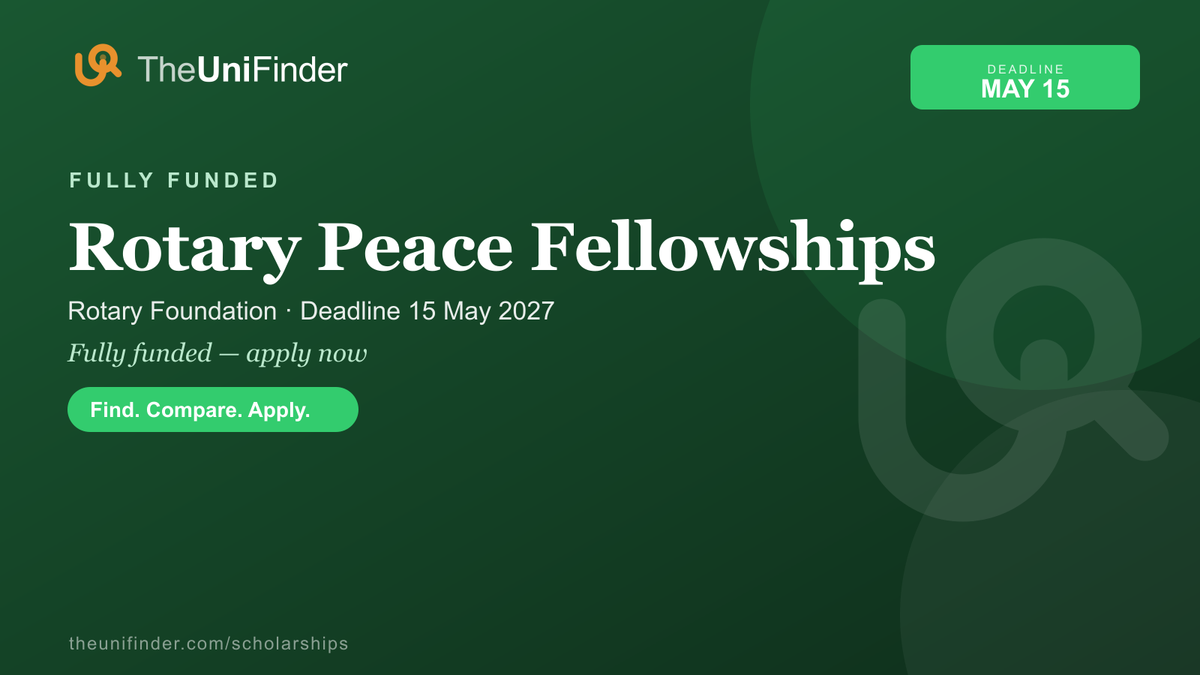
Rotary Foundation
Rotary Peace Fellowships
For professionals committed to peace and development, with relevant work experience and (for the master's) a strong academic background and proficiency in English. Applicants apply through their local Rotary district and are selected globally by The Rotary Foundation for study at a Rotary Peace Center.
full
Funding
€90k
Max
May 15, 2027
Deadline
Frequently asked questions
What is Aalborg University's unique teaching method?
+
Aalborg University (AAU) is internationally recognized for its pioneering problem- and project-based learning (PBL) pedagogy. This approach involves students working collaboratively on real-world problems from their first semester.
What are the tuition fees for international students at Aalborg University?
+
Non-EU/EEA international students pay approximately DKK 60,000–125,000 per year, depending on the program. EU/EEA and Danish students attend tuition-free.
Are there scholarships available for international students?
+
Yes, scholarship opportunities exist for non-EU/EEA students, including the Danish Government Scholarships and the AAU Talent Scholarship, which can cover partial or full tuition waivers.
What are the English language proficiency requirements for international students?
+
For English-taught programs, students typically need an IELTS Academic score of 6.5 overall or a TOEFL iBT score of 83 overall.
What is the estimated monthly living cost for students in Aalborg?
+
Students should budget approximately DKK 8,000–10,000 per month for housing, food, and personal expenses, as Aalborg is considered one of Denmark's more affordable cities.
Last updated