IRAN · TEHRAN
Amirkabir University of Technology
public · Founded 1958 · Languages: fa

In short
Amirkabir University of Technology, founded in 1958, is Iran's oldest and a top-ranked technological university in Tehran. It offers a strong research environment and a wide range of engineering and science programmes for approximately 15,000 students.
Key facts
- Type
- Public
- Founded
- 1958
- Students
- 15,000
- International students
- 300
- Acceptance rate
- 20%
- Tuition (intl)
- €2–4k/yr
- Languages
- FA
- Location
- Tehran, Iran
Amirkabir University of Technology (AUT), also called the Tehran Polytechnic, is a public technological university located in Tehran, Iran. Founded in 1958, AUT is the oldest technical university in Iran and is consistently ranked among the country's top three universities. It excels in Electrical Engineering, Civil Engineering, Aerospace, Mathematics, and Computer Science. The university hosts approximately 15,000 students across eight faculties, offering bachelor's, master's, and doctoral programmes. AUT's research productivity is strong, with a QS world ranking of around 450 reflecting its standing internationally. AUT alumni occupy senior positions across Iranian industry, government, and international academia, making it the country's most prestigious engineering career launchpad.
Why study here
- Iran's oldest and most prestigious technical university with a QS ranking around 450 globally.
- Selective admission ensuring high-calibre peer cohort in engineering and sciences.
- Strong research culture with international publication output.
- Central Tehran location with access to major industry partners and cultural resources.
- Low tuition costs relative to comparable research universities globally.
Student life
AUT students enjoy a vibrant campus life in central Tehran. Student organisations span academic clubs, sports teams, cultural groups, and engineering competitions. The university provides on-campus dining, sports facilities, and libraries. Tehran's broader cultural scene — museums, parks, restaurants, and technology hubs — enriches student life considerably.
Fees
InternationalAnnual tuition for international students approximately EUR 1,500–4,000 depending on degree level and programme.
HomeIranian nationals pay subsidised fees; typically very low (around USD 100–400 per year for government-funded places).
LivingMonthly living costs in Tehran: approximately EUR 400–700 covering accommodation, food, and transport.
Non-Iranian students should contact AUT's International Affairs Office directly for current fee schedules and visa requirements.
Admissions
Academic transcriptsCertified, translated transcripts from all previous institutions
Language proficiencyPersian (Farsi) for most programmes; some postgraduate programmes in English
Entrance examIranian Konkur exam for domestic applicants; separate process for international students via the International Affairs Office
IELTS6.0 (for English-taught postgraduate programmes)
TOEFL iBT79+
Rankings
QS World University Rankings 2025456
National ranking — Iran3
University scholarships
Iranian Government ScholarshipTuition waiver + monthly stipend for eligible international students
AUT Graduate AssistantshipPartial tuition reduction for research assistant positions
Accreditation
Ministry of Science, Research and Technology of Iran; AUT is a member of the International Association of Universities (IAU).
Scholarships
for Iran full funding
Wellcome Trust
Wellcome Trust Fellowships and Grants (for international researchers)
For researchers at different career stages working on health-related science. Wellcome funds a family of fellowships and grants — early-career, career-development, and discovery awards, plus team and translational funding — each with its own eligibility, value, and call deadline. There is no single scholarship application; you apply to the specific scheme that fits your stage and project.
full
Funding
€3000k
Max
Rolling
Deadline
 full funding
Wellcome Trust
Wellcome International Training Fellowships
For early-career researchers based in low- and middle-income countries (outside the high-income world) who want protected time and support for research training in health, often including a PhD or postdoctoral research. Wellcome's scheme names and exact criteria change over time, so applicants should check the current relevant Wellcome funding scheme.
full
Funding
€150k
Max
Rolling
Deadline
 full funding
European Commission - European Research Executive Agency (REA)
Marie Sklodowska-Curie Actions Postdoctoral Fellowships
Open to researchers of any nationality who hold a PhD (or will have defended their doctoral thesis by the call deadline) and have at most 8 years of full-time-equivalent research experience after the PhD. Applicants apply jointly with a host organisation - a university, research institution, business, SME, or other body based in an EU Member State or a country associated to Horizon Europe. European Postdoctoral Fellowships are open to all nationalities for a project inside the EU or an associated country; Global Postdoctoral Fellowships are reserved for EU nationals or long-term residents who carry out a phase in a third country before returning to Europe. Researchers who have been displaced by conflict and those restarting a research career after a break are explicitly encouraged to apply.
full
Funding
€100k
Max
-6d left
Deadline
 full funding
Rotary Foundation
Rotary Peace Fellowships
For professionals committed to peace and development, with relevant work experience and (for the master's) a strong academic background and proficiency in English. Applicants apply through their local Rotary district and are selected globally by The Rotary Foundation for study at a Rotary Peace Center.
full
Funding
€90k
Max
May 15, 2027
Deadline
 full funding
Independent Social Research Foundation (ISRF)
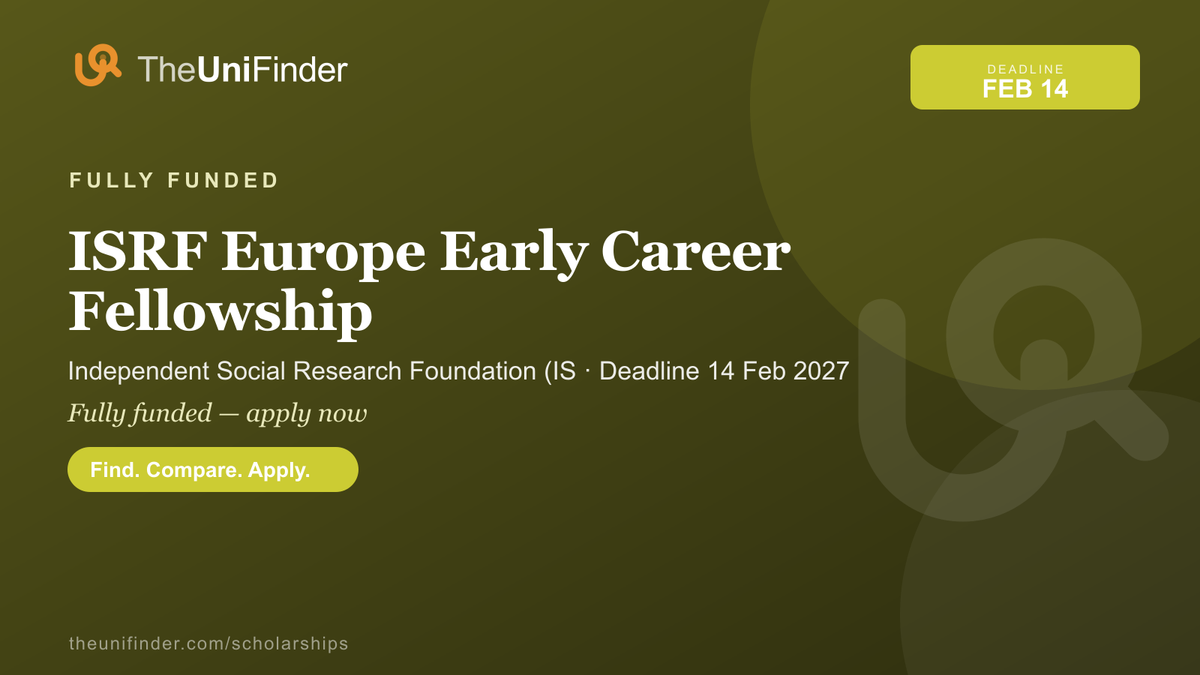
ISRF Europe Early Career Fellowship
Open to early-career researchers in the social sciences and humanities who are within 10 years of their PhD award (career breaks considered) and hold a salaried position at a higher education or research institution, or are independent scholars with a host institution. Research must be hosted at a European institution and address innovative, interdisciplinary social research questions. Open to scholars of all nationalities.
full
Funding
€82k
Max
Feb 14, 2027
Deadline
 full funding
Massachusetts Institute of Technology (MIT)
MIT Need-Based Aid for International Undergraduates
For international undergraduate applicants to MIT, which is need-blind in admission and meets the full demonstrated financial need of every admitted student. Aid is a grant (no loans in the standard package); the amount is set by each family's assessed need.
full
Funding
€80k
Max
Nov 10, 2026
Deadline
Frequently asked questions
What are the main fields of study at Amirkabir University of Technology?
+
Amirkabir University of Technology excels in Electrical Engineering, Civil Engineering, Aerospace, Mathematics, and Computer Science. It offers bachelor's, master's, and doctoral programmes in these and other technical fields.
What is the global ranking of Amirkabir University of Technology?
+
Amirkabir University of Technology has a QS world ranking of around 450. Nationally, it is consistently ranked among the country's top three universities.
How much does it cost to study at Amirkabir University of Technology for international students?
+
Annual tuition for international students is approximately EUR 1,500–4,000, depending on the degree level and programme. International students should contact the International Affairs Office for the most current fee schedules.
What are the living costs for students in Tehran?
+
Monthly living costs in Tehran are estimated to be between EUR 400–700, covering accommodation, food, and transport. This estimate provides a general idea for budgeting purposes.
Does Amirkabir University of Technology offer scholarships for international students?
+
Yes, Amirkabir University of Technology offers scholarships such as the Iranian Government Scholarship, which can include a tuition waiver and monthly stipend for eligible international students. The AUT Graduate Assistantship is also available for research assistant positions.
Last updated