UNITED STATES · REDMOND
DigiPen Institute of Technology
private · Founded 1988 · Languages: en
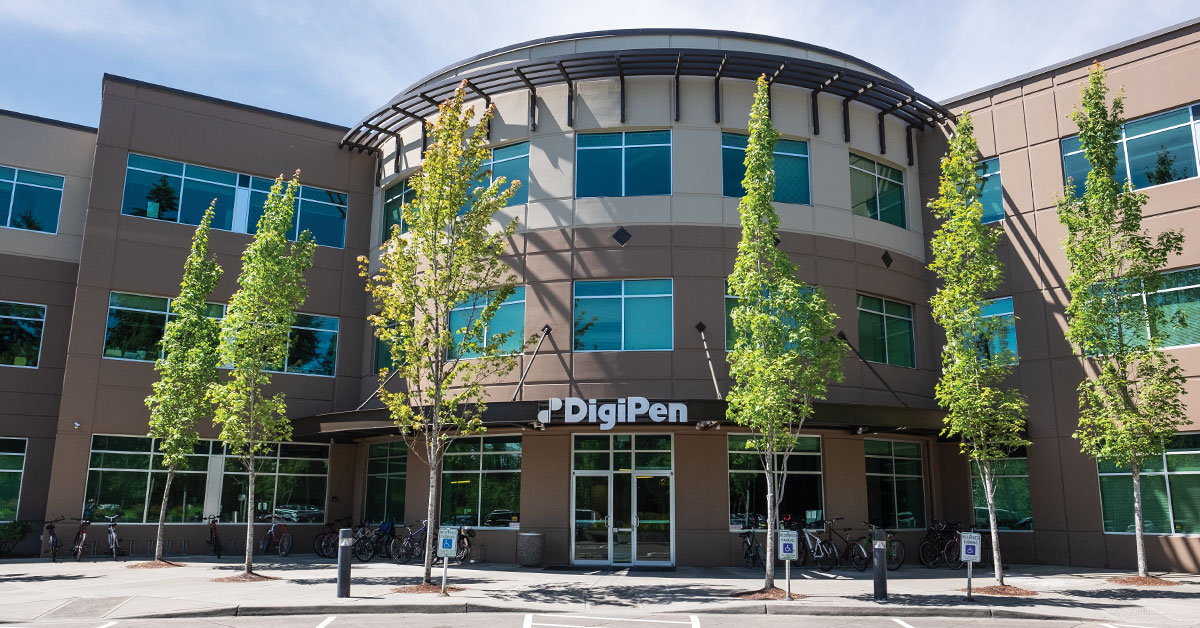
In short
DigiPen Institute of Technology in Redmond, Washington, offers a project-based curriculum in computer science, game design, art, and animation. It is located in a major tech hub, providing excellent career opportunities and industry connections.
Key facts
- Type
- Private
- Founded
- 1988
- Students
- 871
- International students
- 90
- Acceptance rate
- 30%
- Tuition (intl)
- €35–39k/yr
- Languages
- EN
- Location
- Redmond, United States
DigiPen Institute of Technology, established in 1988, is a leading institution in computer science, game design, art, and animation. Located in Redmond, Washington, a global hub for technology and gaming, DigiPen offers a unique, project-based curriculum designed to prepare students for careers in the digital interactive media industries. The university prides itself on a rigorous academic approach that emphasizes practical application and teamwork. Students at DigiPen engage in hands-on projects from their first day, often collaborating to create full video games, animated films, and complex software. This immersive learning environment mirrors real-world production studios, equipping graduates with invaluable experience and a strong portfolio. DigiPen's innovative programs, particularly in Computer Science in Real-Time Interactive Simulation, bridge theoretical knowledge with industry demands. The institute's strong ties to the technology and gaming sectors are reflected in its influential alumni network and partnerships with major companies like Microsoft, Nintendo, and Amazon. This connectivity provides students with exceptional internship and career opportunities. DigiPen consistently earns high rankings for its game design programs, underscoring its commitment to educational excellence and its significant impact on the industry.
Why study here
- Gain practical, real-world experience through a project-based curriculum.
- Benefit from a location in a major technology and gaming industry hub with excellent career prospects.
- Join an extensive and influential alumni network that impacts the global digital media landscape.
- Study pioneering programs, such as Computer Science in Real-Time Interactive Simulation, recognized for their industry relevance.
Student life
DigiPen fosters a vibrant student community with a variety of clubs, events, and a strong emphasis on creativity and innovation both inside and outside the classroom. Students are encouraged to connect and collaborate, enriching their academic experience and personal growth.
Fees
InternationalFor international undergraduate students, direct costs (tuition, administrative fee, student engagement fee, new student orientation fee) total $45,900 per year. Indirect costs, including living expenses, housing, food, books, supplies, laptop, software, transportation, and personal expenses, are estimated at $28,468 per year, bringing the total estimated cost of attendance to $74,468.
HomeFor domestic undergraduate students living off-campus, direct costs (tuition, administrative fee, student engagement fee, new student orientation fee) total $41,270 per year. Indirect costs, including living expenses, housing, food, books, supplies, laptop, software, loan fees, transportation, and personal expenses, are estimated at $28,650 per year, for a total estimated cost of attendance of $69,920. For those living with parents, the total estimated cost is $57,072.
LivingEstimated annual living expenses, housing, and food are $21,552 for students living off-campus (including DigiPen Housing). This is an indirect cost not billed directly by the school.
Tuition is based on 15-22 credits per semester. Students taking fewer than 15 credits are charged per credit. A laptop computer is budgeted as a one-time expense during the first semester. Some programs, like BFA and BA in Music and Sound Design, have additional software costs.
Admissions
High School TranscriptRequired, with strong math and science coursework recommended.
Personal EssayRequired, describing goals and interest in interactive media.
PortfolioRecommended for art, animation, and design degrees.
Letters of RecommendationOptional but encouraged.
TOEFL iBT80 minimum
IELTS6.5 minimum
Rankings
Princeton ReviewTop Game Design School
University scholarships
DigiPen Merit ScholarshipsVaries by academic achievement
DigiPen Presidential ScholarshipPartial to full tuition
Accreditation
DigiPen Institute of Technology gained accreditation in 1998 and is accredited by the Northwest Commission on Colleges and Universities (NWCCU).
For international students
United StatesStudent visa & funds
International students primarily enter on the F-1 visa, which requires enrolment at a SEVP-certified institution. Before the visa interview the school issues a Form I-20 — a certificate of eligibility — for which a Designated School Official must verify documented funds covering tuition, living expenses and travel for the first year, plus a reliable source for subsequent years. The financial evidence must be specific and from an identified source.
Working while you study
F-1 students may work on campus up to 20 hours per week while classes are in session and full-time during official breaks, with no separate authorization needed. Off-campus work is generally not permitted in the first academic year. After one academic year in good standing, students may use Curricular Practical Training (CPT) for paid work that is an integral part of the curriculum, authorized by the school; other off-campus work requires an approved Employment Authorization Document from USCIS.
After you graduate
After completing a degree, F-1 students may apply for Optional Practical Training (OPT) — up to 12 months of work authorization in a related field — by filing Form I-765 and receiving an EAD before starting work. Graduates of a degree on the DHS STEM Designated Degree Program List may apply for a 24-month STEM OPT extension, for up to 36 months total. The extension requires an E-Verify employer and a qualifying STEM degree earned within the previous ten years.
English tests
- IELTSUG 6.0–6.5; PG 6.5–7.0; top-tier programs 7.0–7.5
- TOEFL iBTUG 80–100; PG 90–110; selective research universities 100+
- PTE AcademicUG 50–60; PG 55–70; highly selective programs 65+
Main intakes
AugustJanuary
Typical living cost
€1,420/month
Approximate all-in student budget; major cities run higher.
SourcesStudy in the States — Students and the Form I-20 · Study in the States — Financial ability · USCIS — Students and employment · USCIS — Optional Practical Training (OPT) for F-1 students · USCIS — STEM OPT extension · LeapScholar — Minimum IELTS scores for USA universities · Mastersportal — Student living costs in the USA (2025–2026)
Programs
a selectionDigiPen Institute of Technology · United States
B.F.A. in Digital Art and Animation
The Bachelor of Fine Arts (BFA) in Digital Art and Animation program equips students with a strong foundation in classical art principles and cutting-edge digital tools. You will learn observational drawing, perspective, color theory, and composition, then apply these fundamentals to 3D modeling, sculpting, visual effects, lighting, texturing, simulations, technical art, and 3D animation. The program emphasizes hands-on experience through multidisciplinary team projects, where you will collaborate with students from other degree programs to create playable video games or 3D animated films. Graduates are prepared for careers in the game, animation, and computer graphics industries with a portfolio of professional-quality projects and a well-developed skillset.
Bachelor's
Level
—
Tuition
48 mo
Duration
DigiPen Institute of Technology · United States
B.S. in Computer Science and Game Design
This four-year program focuses on the intersection of computer science and game design, preparing students to become game programmers with a designer's mindset. It emphasizes foundational programming skills in C and C++, alongside core concepts in mathematics, physics, and computer science. The curriculum is project-driven, with yearly team projects designed to simulate real-world game development environments. Graduates will be equipped to translate design concepts into functional code, making them valuable members of any development team.
Bachelor's
Level
—
Tuition
48 mo
Duration
DigiPen Institute of Technology · United States
Bachelor of Arts in Game Design
This four-year Bachelor of Arts in Game Design program focuses on understanding the player's experience and making intentional design choices to create engaging games. You will learn the core concepts and techniques that underpin both modern video games and traditional analog games. The curriculum emphasizes practical application through yearly game projects where you will collaborate with students in programming, art, and audio disciplines. In your junior year, you can specialize in areas such as systems, narrative, level, technical, user experience (UX), or user research design, allowing you to hone your focus on specific industry passions.
Bachelor's
Level
—
Tuition
48 mo
Duration
DigiPen Institute of Technology · United States
Bachelor of Arts in Music and Sound Design
The Bachelor of Arts in Music and Sound Design program prepares students for careers in creating music and sound for digital media, including video games and film. This four-year program combines music composition and theory with audio engineering, recording, and mixing techniques. Students develop a hybrid skillset by learning to compose soundtracks and design sound effects. The curriculum emphasizes practical application through interdisciplinary project teams, where students collaborate with programmers, artists, and game designers to create original media projects from concept to completion. This hands-on approach results in a professional portfolio showcasing skills in composition, design, production, and implementation.
Bachelor's
Level
—
Tuition
48 mo
Duration
DigiPen Institute of Technology · United States
Bachelor of Science in Computer Science
The Bachelor of Science in Computer Science program at DigiPen equips students with the foundational knowledge and practical skills needed for careers in the rapidly evolving technology sector. The curriculum covers essential programming languages like C and C++, databases, networks, and distributed computing. A core component of the program involves multidisciplinary team projects, where students collaborate on yearly video game or computer science projects, simulating real-world professional environments. This hands-on approach prepares graduates for diverse roles in both the game industry and broader tech companies. This degree is suitable for students with or without prior coding experience. The program emphasizes a strong understanding of complex algorithms and sophisticated data structures, ensuring graduates are well-prepared to address the demands of emerging technologies and software engineering advancements. Students will gain practical experience through project-based learning and engagement with faculty who have industry experience.
Bachelor's
Level
—
Tuition
48 mo
Duration
DigiPen Institute of Technology · United States
Bachelor of Science in Computer Science and Digital Audio
The Bachelor of Science in Computer Science and Digital Audio program focuses on the intersection of programming and audio engineering, specifically for interactive digital media like video games. You'll start with foundational programming (C, C++) and math, then move into music theory, sound design, production, and digital audio workstations. The curriculum emphasizes hands-on experience through semester- and year-long team projects where you'll develop original video games with sophisticated interactive audio systems. This program prepares you with a diverse portfolio and a strong background in sound production and tools programming for careers in the game and tech industries.
Bachelor's
Level
—
Tuition
48 mo
Duration
Scholarships
for United States full funding
Duke University
Karsh International Scholarship Program
Open to international (non-U.S. citizen, non-permanent-resident) high school students applying for first-year undergraduate admission to Duke University. Candidates must demonstrate financial need through Duke's need-based aid process, show interdisciplinary academic curiosity, and have a record of community engagement. There is no separate scholarship form; international applicants who indicate they are applying for financial aid are automatically considered for the Karsh award.
full
Funding
€320k
Max
Jan 2, 2027
Deadline
 full funding
University of Miami (with the Stamps Family Charitable Foundation)
University of Miami Stamps Scholarship
Open to high school seniors, both domestic (U.S.) and international, applying for first-year undergraduate admission to the University of Miami through Early Decision I or Early Action. Applicants are automatically considered with no separate scholarship form; they must submit all first-year admission requirements and demonstrate strong academic achievement, leadership, and community involvement. Semi-finalists complete a Zoom interview.
full
Funding
€260k
Max
Nov 1, 2026
Deadline
 full funding
QuestBridge
QuestBridge National College Match Scholarship
Open to high-achieving US high school seniors from low-income backgrounds who are US citizens, permanent residents, or students studying in the US regardless of citizenship. Competitive applicants typically earn mostly A's in challenging courses, rank in the top 5-10% of their class, and have strong standardised test results (SAT/PSAT above 1310 or ACT above 28), though each application is read in context. Applicants must demonstrate strong writing, intellectual curiosity and determination through essays and recommendations. Matched students must attend a partner college as a binding-early-decision commitment.
full
Funding
€185k
Max
10d left
Deadline
full fundingArgonne National Laboratory
Maria Goeppert Mayer Fellowship at Argonne National Laboratory
Open to early-career scientists and engineers of all nationalities who hold a PhD awarded within the last three years at the time of application, or who will complete the PhD before the fellowship start date. Research interests must align with Argonne's mission areas. U.S. citizenship is required for national-security-related projects (Detection of Imaging Signatures).
full
Funding
€130k
Max
15d left
Deadline
 partial funding
Boustany Foundation / Harvard Business School
Boustany MBA Harvard Scholarship
Open to candidates of any nationality (priority to those of Lebanese descent) who have received an offer of admission to the Harvard MBA programme and have a strong academic background.
partial
Funding
€100k
Max
May 31, 2027
Deadline
 full funding
Stanford University
Knight-Hennessy Scholars
Open to citizens of any country who earned their first/bachelor's degree within the last ~7 years (or will by the Stanford start) and who apply for and gain admission to a full-time Stanford graduate program. Selection seeks independence of thought, purposeful leadership, and a civic mindset.
full
Funding
€90k
Max
22d left
Deadline
Frequently asked questions
What are the estimated costs for international students at DigiPen?
+
For international undergraduate students, direct costs like tuition and fees total $45,900 per year. Including estimated indirect costs for living expenses, housing, food, and other necessities, the total estimated cost of attendance is $74,468 per year.
Where is DigiPen Institute of Technology located and why is it significant?
+
DigiPen is located in Redmond, Washington, a major technology hub. This location provides students with significant access to internships and career opportunities within the digital interactive media and gaming industries.
What is DigiPen's approach to education?
+
DigiPen utilizes a project-based curriculum, emphasizing hands-on learning and teamwork from the very first day. This approach prepares students for careers by having them create video games, animated films, and software, mirroring real-world production studios.
What are the English proficiency requirements for international applicants?
+
International applicants must demonstrate English proficiency. The minimum required scores are 80 for the TOEFL iBT and 6.5 for the IELTS.
What are some of the key benefits of studying at DigiPen?
+
Students gain practical, real-world experience through projects, benefit from a prime location in a tech hub, join an influential alumni network, and study pioneering programs relevant to the industry.
Last updated