UNITED STATES · CAMBRIDGE
Massachusetts Institute of Technology
private · Founded 1861 · Languages: en
In short
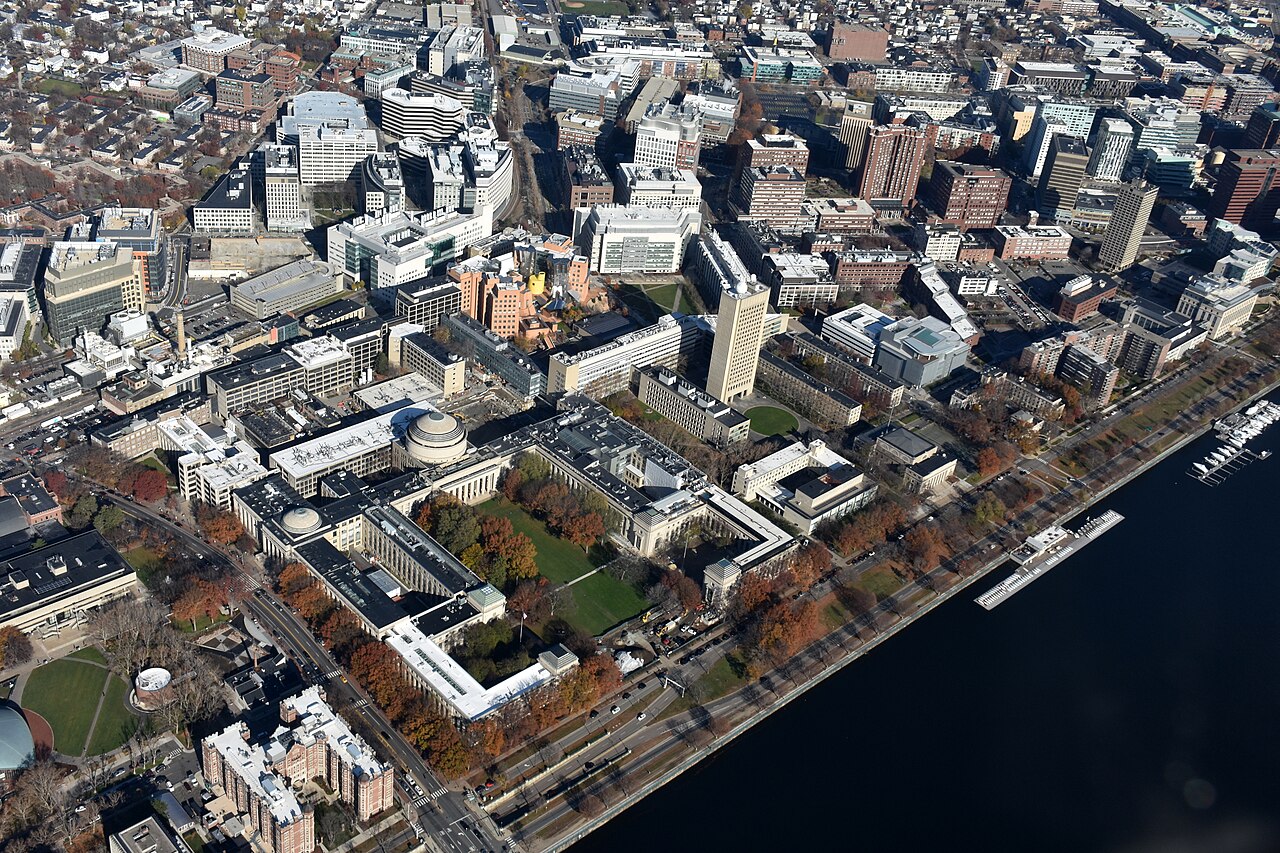
The Massachusetts Institute of Technology (MIT) is a world-leading university in science, engineering, and technology, founded in 1861. It is located in Cambridge, Massachusetts, and is known for transformative research and a culture of rigorous inquiry and problem-solving.
Key facts
- Type
- Private
- Founded
- 1861
- Students
- 11,574
- International students
- 3,800
- Acceptance rate
- 4%
- Tuition (intl)
- €55–60k/yr
- Languages
- EN
- Location
- Cambridge, United States
The Massachusetts Institute of Technology (MIT) is the world's top-ranked university for science, engineering, and technology, located in Cambridge, Massachusetts. Founded in 1861, MIT has shaped modern civilisation through transformative research in fields from computing and AI to biomedical science and clean energy. Its 11,500 students work alongside faculty who include over 100 Nobel laureates, in a culture that prizes rigorous inquiry, creative problem-solving, and real-world impact.
Why study here
- Ranked #1 globally by QS for over a decade, with unmatched depth in STEM disciplines.
- Access to world-leading labs and research centres including CSAIL, MIT Media Lab, and the Broad Institute.
- UROP programme lets undergraduates conduct paid research from their first year.
- Cambridge/Boston location places students at the heart of the world's densest innovation and biotech cluster.
- Need-blind admissions for all nationalities — MIT meets 100% of demonstrated financial need.
Student life
MIT's campus life is rich and diverse, with over 500 student organisations covering interests from robotics to theatre. There are 33 varsity sports teams and 31 club sports. The arts are central to campus life, with over 3,500 contemporary artworks on campus and more than half of undergraduates taking arts classes each year. Living groups including fraternities, sororities, and independent living groups each have distinctive cultures and traditions. Boston and Cambridge offer world-class museums, restaurants, and entertainment within easy reach.
Fees
InternationalAnnual undergraduate tuition is approximately USD 59,750 (~EUR 55,000). Graduate tuition varies by programme, typically USD 57,000–60,000.
HomeSame tuition as international students: approximately USD 59,750. MIT meets 100% of demonstrated financial need for all admitted students.
LivingAnnual room and board costs approximately USD 19,000 (~EUR 17,500). Total estimated annual cost of attendance is approximately USD 82,000.
MIT is need-blind for all applicants regardless of citizenship. Average need-based scholarship for undergraduates is over USD 50,000 per year.
Admissions
High School TranscriptStrong academic record, particularly in maths and sciences.
SAT/ACTTest-optional; students who submit scores typically have SAT 1510–1580 or ACT 34–36.
Letters of RecommendationTwo teacher recommendations (one maths/science, one humanities) plus a school counsellor letter.
EssaysMIT-specific essays required; creativity and authenticity are valued.
TOEFL iBT100+ recommended
IELTS7.0+ recommended
Rankings
QS World University Rankings 20251
Times Higher Education World University Rankings 20255
US News Best Global Universities 20252
University scholarships
MIT Need-Based AidAverage USD 50,000+ per year
MIT Fellowship (Graduate)Full tuition + stipend ~USD 40,000/year
NSF Graduate Research FellowshipUSD 37,000/year stipend
Accreditation
Accredited by the New England Commission of Higher Education (NECHE). Engineering programmes accredited by ABET.
For international students
United StatesStudent visa & funds
International students primarily enter on the F-1 visa, which requires enrolment at a SEVP-certified institution. Before the visa interview the school issues a Form I-20 — a certificate of eligibility — for which a Designated School Official must verify documented funds covering tuition, living expenses and travel for the first year, plus a reliable source for subsequent years. The financial evidence must be specific and from an identified source.
Working while you study
F-1 students may work on campus up to 20 hours per week while classes are in session and full-time during official breaks, with no separate authorization needed. Off-campus work is generally not permitted in the first academic year. After one academic year in good standing, students may use Curricular Practical Training (CPT) for paid work that is an integral part of the curriculum, authorized by the school; other off-campus work requires an approved Employment Authorization Document from USCIS.
After you graduate
After completing a degree, F-1 students may apply for Optional Practical Training (OPT) — up to 12 months of work authorization in a related field — by filing Form I-765 and receiving an EAD before starting work. Graduates of a degree on the DHS STEM Designated Degree Program List may apply for a 24-month STEM OPT extension, for up to 36 months total. The extension requires an E-Verify employer and a qualifying STEM degree earned within the previous ten years.
English tests
- IELTSUG 6.0–6.5; PG 6.5–7.0; top-tier programs 7.0–7.5
- TOEFL iBTUG 80–100; PG 90–110; selective research universities 100+
- PTE AcademicUG 50–60; PG 55–70; highly selective programs 65+
Main intakes
AugustJanuary
Typical living cost
€1,420/month
Approximate all-in student budget; major cities run higher.
SourcesStudy in the States — Students and the Form I-20 · Study in the States — Financial ability · USCIS — Students and employment · USCIS — Optional Practical Training (OPT) for F-1 students · USCIS — STEM OPT extension · LeapScholar — Minimum IELTS scores for USA universities · Mastersportal — Student living costs in the USA (2025–2026)
Programs
a selectionMassachusetts Institute of Technology · United States
Algorithmic Lower Bounds: Fun with Hardness Proofs
This graduate-level course focuses on the theory of computation and algorithmic lower bounds, specifically exploring techniques for proving hardness in computational problems. The material covers fundamental concepts in complexity theory and delves into practical applications through hardness proofs in various game scenarios. It is designed for students with a strong background in theoretical computer science.
PhD
Level
—
Tuition
—
Duration
Massachusetts Institute of Technology · United States
Artificial Intelligence in Health Care
This online short course from MIT Sloan School of Management and the MIT J-Clinic is designed for health care leaders to understand the transformative potential of Artificial Intelligence (AI) in the health care industry. The course explores various AI technologies, their applications, limitations, and the opportunities they present. As patient data grows, AI offers efficient data processing capabilities that surpass human capacity, leading to innovations in areas like cancer treatment, patient care, and risk prediction. You will gain a comprehensive understanding of AI's role in health care through real-world case studies. The program guides you in evaluating AI techniques for your specific context, examining adoption challenges in hospital processes and resource management. Learn from MIT faculty and health care experts about AI's use in diagnosis, patient monitoring, and data management, and develop a framework for assessing AI viability in your health care setting.
Certificate
Level
€3k
Tuition
6 mo
Duration
Massachusetts Institute of Technology · United States
Blockchain and Crypto Applications: From Decentralized Finance to Web 3
This online short course, developed by the MIT Sloan School of Management, offers a balanced perspective on the cryptocurrency space, focusing on the underlying blockchain technology and its business applications. Over eight weeks, you will explore the economics of blockchain, including digital assets, stablecoins, Decentralized Finance (DeFi), Non-Fungible Tokens (NFTs), and Web 3. The course examines current trends, public opinion, and the evolving legal and regulatory landscape, providing insights into the future possibilities of blockchain technology across various sectors. Guided by MIT faculty and industry experts, you will gain a practical understanding of the crypto ecosystem, from its origins to emerging concepts like Web 3. The curriculum is designed to help you differentiate between fact and fiction in the crypto world, understand divergent viewpoints, and navigate regulatory issues. You will also develop a primer for an early-stage project idea, considering key technical, market, and regulatory challenges. This program is ideal for experienced professionals and leaders seeking to enhance their roles, acquire new skills, or pivot into blockchain-related careers. It is particularly beneficial for those planning to invest in or launch ventures within the blockchain or crypto industries.
Certificate
Level
€3k
Tuition
8 mo
Duration
Massachusetts Institute of Technology · United States
Cellular Solids: Structure, Properties and Applications
This course delves into the structure, properties, and applications of cellular solids. It provides a review of fundamental concepts, with a specific focus on honeycombs and their mechanical characteristics. The program explores the relationship between the physical structure of these materials and their performance in various engineering contexts. Through lectures and project examples, students will gain a comprehensive understanding of how cellular solids function and where they can be utilized.
Master's
Level
—
Tuition
24 mo
Duration
Massachusetts Institute of Technology · United States
Chemical and Biological Reaction Engineering
This course delves into the analysis of chemical and biological reaction systems. It applies core concepts like reaction rate, stoichiometry, and equilibrium. The curriculum focuses on deriving rate expressions from mechanisms and steady-state assumptions. You will also learn to design chemical and biochemical reactors by integrating chemical kinetics, transport phenomena, and mass/energy balances.
Bachelor's
Level
—
Tuition
—
Duration
Massachusetts Institute of Technology · United States
Communication Skills for Academics
This course is designed to enhance your ability to communicate effectively within an academic context. Success as a scholar hinges on your skills in conveying information to peers, colleagues, students, and the public. The course emphasizes not only general communication principles like audience awareness but also the specific conventions of academic writing and presentation. The primary goals of this course are threefold. Firstly, you will learn guidelines for producing well-structured academic communications. Secondly, you will gain practical experience through assignments and receive constructive feedback. Major assignments include writing or revising a manuscript for publication or a conference paper, and delivering a conference presentation or job talk. These will be based on your own doctoral research. Thirdly, the course will explore professional practices related to academic work, such as the publication process and job searching.
Master's
Level
—
Tuition
—
Duration
Scholarships
for United States full funding
Duke University
Karsh International Scholarship Program
Open to international (non-U.S. citizen, non-permanent-resident) high school students applying for first-year undergraduate admission to Duke University. Candidates must demonstrate financial need through Duke's need-based aid process, show interdisciplinary academic curiosity, and have a record of community engagement. There is no separate scholarship form; international applicants who indicate they are applying for financial aid are automatically considered for the Karsh award.
full
Funding
€320k
Max
Jan 2, 2027
Deadline
 full funding
University of Miami (with the Stamps Family Charitable Foundation)
University of Miami Stamps Scholarship
Open to high school seniors, both domestic (U.S.) and international, applying for first-year undergraduate admission to the University of Miami through Early Decision I or Early Action. Applicants are automatically considered with no separate scholarship form; they must submit all first-year admission requirements and demonstrate strong academic achievement, leadership, and community involvement. Semi-finalists complete a Zoom interview.
full
Funding
€260k
Max
Nov 1, 2026
Deadline
 full funding
QuestBridge
QuestBridge National College Match Scholarship
Open to high-achieving US high school seniors from low-income backgrounds who are US citizens, permanent residents, or students studying in the US regardless of citizenship. Competitive applicants typically earn mostly A's in challenging courses, rank in the top 5-10% of their class, and have strong standardised test results (SAT/PSAT above 1310 or ACT above 28), though each application is read in context. Applicants must demonstrate strong writing, intellectual curiosity and determination through essays and recommendations. Matched students must attend a partner college as a binding-early-decision commitment.
full
Funding
€185k
Max
9d left
Deadline
full fundingArgonne National Laboratory
Maria Goeppert Mayer Fellowship at Argonne National Laboratory
Open to early-career scientists and engineers of all nationalities who hold a PhD awarded within the last three years at the time of application, or who will complete the PhD before the fellowship start date. Research interests must align with Argonne's mission areas. U.S. citizenship is required for national-security-related projects (Detection of Imaging Signatures).
full
Funding
€130k
Max
14d left
Deadline
 partial funding
Boustany Foundation / Harvard Business School
Boustany MBA Harvard Scholarship
Open to candidates of any nationality (priority to those of Lebanese descent) who have received an offer of admission to the Harvard MBA programme and have a strong academic background.
partial
Funding
€100k
Max
May 31, 2027
Deadline
 full funding
Stanford University
Knight-Hennessy Scholars
Open to citizens of any country who earned their first/bachelor's degree within the last ~7 years (or will by the Stanford start) and who apply for and gain admission to a full-time Stanford graduate program. Selection seeks independence of thought, purposeful leadership, and a civic mindset.
full
Funding
€90k
Max
21d left
Deadline
Frequently asked questions
What is the estimated cost of attendance for international students at MIT?
+
The estimated annual undergraduate tuition is approximately USD 59,750. Including room and board, the total estimated annual cost of attendance is around USD 82,000. Graduate tuition fees vary by program.
Does MIT offer financial aid or scholarships for international students?
+
Yes, MIT is need-blind for all applicants, regardless of citizenship, and meets 100% of demonstrated financial need. The average need-based scholarship for undergraduates exceeds USD 50,000 annually.
What are the English language proficiency requirements for international applicants?
+
MIT recommends a TOEFL iBT score of 100+ or an IELTS score of 7.0+. These scores are considered during the holistic review of your application.
What is the academic profile typically expected from successful applicants?
+
Successful applicants usually have a strong academic record, especially in mathematics and sciences. While test-optional, submitted SAT scores are typically between 1510-1580, and ACT scores between 34-36.
Where is MIT located and what is the surrounding environment like?
+
MIT is located in Cambridge, Massachusetts, a city renowned for its intellectual environment and close proximity to Boston. This location places students at the center of a major innovation and biotech hub.
Last updated