In short
Qatar University is the nation's only public research university, offering a wide range of programs with international student-friendly English-medium instruction in many fields. Located in the vibrant capital of Doha, it provides modern facilities and a strategic role in Qatar's development vision.
Key facts
- Type
- Public
- Founded
- 1973
- Students
- 20,000
- International students
- 5,000
- Acceptance rate
- 58%
- Tuition (intl)
- €5–10k/yr
- Languages
- EN, AR
- Location
- Doha, Qatar
Qatar University (QU) is the only government-funded public research university in Qatar, established in 1973 by Emiri decree. Located in Doha, QU serves over 20,000 students across colleges covering arts and sciences, business, education, engineering, health sciences, law, medicine, pharmacy, and Islamic studies. Ranked the top university in Qatar and among the best in the Arab world, QU is a cornerstone of Qatar National Vision 2030, driving the country's transformation into a knowledge-based economy.
Why study here
- Qatar's top-ranked university and highest-profile research institution in the country
- Wide academic breadth spanning engineering, medicine, business, law, and Islamic studies
- Strategic role in Qatar National Vision 2030 with strong government investment in research and infrastructure
- International student-friendly environment with English-medium instruction in many programs
- Located in Doha, a rapidly growing global city with a high standard of living and career opportunities
Student life
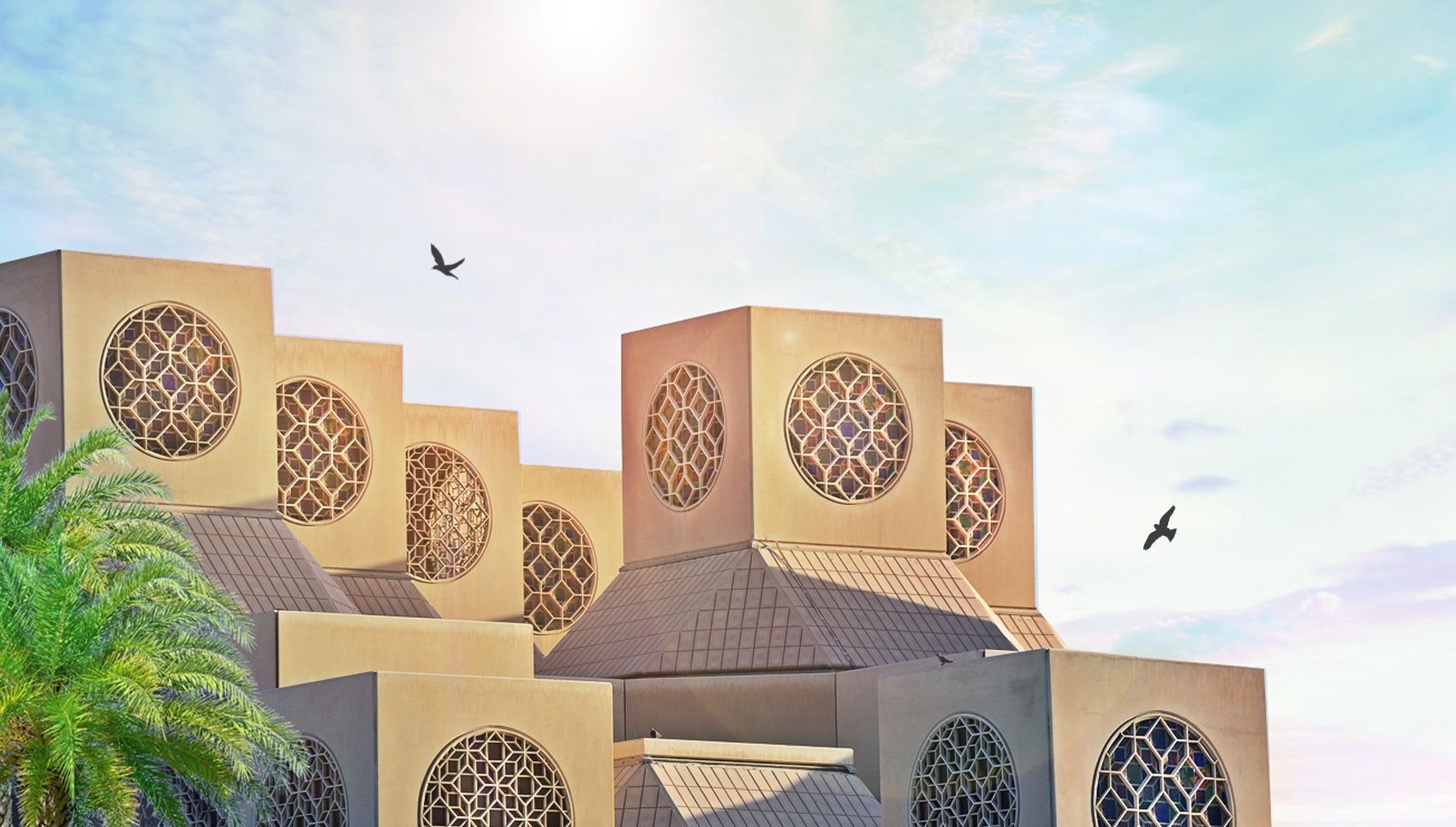
Qatar University offers a rich campus life with diverse student organizations, sports facilities, cultural events, and comprehensive student affairs services. The modern campus blends traditional Islamic architecture with contemporary facilities. Students benefit from on-campus housing, health services, career support, and an active international student community. Doha's cosmopolitan atmosphere, safety, and year-round sunshine add to the overall experience.
Fees
InternationalApprox. QAR 1,200 per credit hour (approx. EUR 300) for non-Qatari undergraduate students; graduate fees vary by program, typically QAR 500–1,200 per credit hour
HomeQatari nationals study free of charge; non-Qatari residents pay standard tuition rates
LivingApprox. QAR 5,000–10,000/month (EUR 1,200–2,400) in Doha covering accommodation, food, transport, and personal costs
Tuition fees are set per credit hour and reviewed annually. On-campus housing is available at additional cost. Living costs in Doha are relatively high.
Admissions
UndergraduateSecondary school certificate (recognized high school diploma) with competitive GPA; specific subject prerequisites vary by college
Postgraduate taughtBachelor's degree from a recognized institution with minimum GPA (typically 2.5–3.0 on a 4.0 scale depending on program)
PhDMaster's degree from a recognized institution; research proposal and faculty supervisor required
English proficiencyIELTS or TOEFL may be required for non-native English speakers for English-medium programs
IELTS5.5–6.0 depending on program
TOEFL iBT61–79 depending on program
Rankings
QS World University Rankings 2024247
QS Arab Region Rankings 2024Top 10
Times Higher Education World Rankings401–500
University scholarships
QU Merit ScholarshipPartial to full tuition waiver for high-achieving undergraduate students
QU Graduate Research AssistantshipStipend and tuition support for graduate research students
Student Research GrantFunding for undergraduate and graduate research projects via Office of Research Support
Accreditation
Qatar University is institutionally accredited by the WASC Senior College and University Commission (WSCUC). Many colleges and programs hold specialized international accreditations including AACSB (business), ABET (engineering), and LCME (medicine).
Programs
a selectionQatar University · Qatar
Bachelor of Architecture
The Bachelor of Architecture program at Qatar University's College of Engineering provides a comprehensive education in architectural design and urban planning. It is designed to equip students with the knowledge and skills necessary to address contemporary challenges in the built environment, focusing on critical thinking, creative problem-solving, and sustainable design practices. The curriculum integrates theoretical learning with practical application, preparing graduates for professional practice and further academic pursuits.
Bachelor's
Level
€3k
Tuition
60 mo
Duration
Qatar University · Qatar
Foundation Program - Mathematics
The Foundation Program at Qatar University offers a Pre-Calculus course designed to prepare students for university-level calculus. This course covers essential algebraic and trigonometric concepts, laying the groundwork for further study in mathematics and related fields. The program aims to equip students with the necessary analytical and problem-solving skills for success in their academic journey.
Bachelor's
Level
—
Tuition
—
Duration
Qatar University · Qatar
M.Sc. in Applied Statistics
The Master of Science in Applied Statistics program is designed to provide students with a strong foundation in statistical theory and methods, along with practical experience in applying these techniques to real-world problems. This program aims to equip graduates with the analytical and quantitative skills necessary for successful careers in various fields that rely on data analysis and interpretation. The curriculum covers core statistical concepts, including probability, statistical inference, regression analysis, multivariate statistics, and experimental design. Students will also learn to use statistical software for data manipulation, analysis, and visualization. The program emphasizes the development of critical thinking and problem-solving skills, enabling graduates to tackle complex challenges in diverse industries.
Master's
Level
—
Tuition
24 mo
Duration
Qatar University · Qatar
Master of Business Administration
The Master of Business Administration (MBA) program at Qatar University is designed to equip students with advanced knowledge and skills in various aspects of business management. This program aims to develop leaders who can effectively navigate the complexities of the modern business world, fostering innovation, strategic thinking, and ethical decision-making. The curriculum is structured to provide a comprehensive understanding of core business functions while allowing for specialization.
Master's
Level
€27k
Tuition
24 mo
Duration
Qatar University · Qatar
Master of Science in Computer Science
The Master of Science in Computer Science program at Qatar University's College of Engineering offers advanced studies in the field. It aims to equip students with specialized knowledge and research skills in various areas of computer science, preparing them for careers in academia and industry. The program focuses on theoretical foundations, practical applications, and cutting-edge research within the discipline.
Master's
Level
Free
Tuition
24 mo
Duration
Qatar University · Qatar
Master of Science in Gas and Process Engineering
The Master of Science in Gas and Process Engineering program at Qatar University equips students with advanced knowledge and skills in the field of gas and process engineering. This program is designed to meet the growing demand for specialized engineers in Qatar's energy sector and beyond. Students will engage with complex engineering challenges, focusing on the efficient and sustainable processing of natural gas and other related industrial processes.
Master's
Level
€21k
Tuition
24 mo
Duration
Scholarships
for Qatarfull fundingMinistry of Education and Higher Education, Qatar
Qatar Government Scholarships
Open to Qatari nationals who hold a high school diploma or higher qualification, meet the required academic performance standards, and apply to approved universities and programs in Qatar or abroad.
full
Funding
€50k
Max
13d left
Deadline
 full funding
Doha Institute for Graduate Studies
Doha Institute for Graduate Studies Scholarships
Open to applicants of all nationalities, including Qatari citizens and international students. Applicants must hold a Bachelor's degree, with final-year undergraduates also eligible if they can provide the required transcripts. There is no age restriction, and admission is available across multiple academic fields. IELTS or TOEFL is not required; a university-issued English proficiency certificate is accepted.
full
Funding
—
Max
Jan 15, 2027
Deadline
 full funding
Wellcome Trust
Wellcome Trust Fellowships and Grants (for international researchers)
For researchers at different career stages working on health-related science. Wellcome funds a family of fellowships and grants — early-career, career-development, and discovery awards, plus team and translational funding — each with its own eligibility, value, and call deadline. There is no single scholarship application; you apply to the specific scheme that fits your stage and project.
full
Funding
€3000k
Max
Rolling
Deadline
 full funding
Wellcome Trust
Wellcome International Training Fellowships
For early-career researchers based in low- and middle-income countries (outside the high-income world) who want protected time and support for research training in health, often including a PhD or postdoctoral research. Wellcome's scheme names and exact criteria change over time, so applicants should check the current relevant Wellcome funding scheme.
full
Funding
€150k
Max
Rolling
Deadline
 full funding
European Commission - European Research Executive Agency (REA)
Marie Sklodowska-Curie Actions Postdoctoral Fellowships
Open to researchers of any nationality who hold a PhD (or will have defended their doctoral thesis by the call deadline) and have at most 8 years of full-time-equivalent research experience after the PhD. Applicants apply jointly with a host organisation - a university, research institution, business, SME, or other body based in an EU Member State or a country associated to Horizon Europe. European Postdoctoral Fellowships are open to all nationalities for a project inside the EU or an associated country; Global Postdoctoral Fellowships are reserved for EU nationals or long-term residents who carry out a phase in a third country before returning to Europe. Researchers who have been displaced by conflict and those restarting a research career after a break are explicitly encouraged to apply.
full
Funding
€100k
Max
-7d left
Deadline
 full funding
Rotary Foundation
Rotary Peace Fellowships
For professionals committed to peace and development, with relevant work experience and (for the master's) a strong academic background and proficiency in English. Applicants apply through their local Rotary district and are selected globally by The Rotary Foundation for study at a Rotary Peace Center.
full
Funding
€90k
Max
May 15, 2027
Deadline
Frequently asked questions
What are the tuition fees for international students at Qatar University?
+
Non-Qatari undergraduate students typically pay around QAR 1,200 (approximately EUR 300) per credit hour. Graduate fees vary by program but generally range from QAR 500 to QAR 1,200 per credit hour. Tuition is reviewed annually and is charged per credit hour.
What are the living costs for students in Doha?
+
Living costs in Doha, including accommodation, food, transport, and personal expenses, are estimated to be between QAR 5,000 and QAR 10,000 per month (EUR 1,200–2,400). On-campus housing is available at an additional cost.
Does Qatar University require English proficiency tests for international students?
+
Yes, non-native English speakers may need to demonstrate English proficiency. Required scores typically range from IELTS 5.5–6.0 or TOEFL iBT 61–79, depending on the specific program.
What are the admission requirements for undergraduate programs at Qatar University?
+
Undergraduate admission requires a recognized secondary school certificate (high school diploma) with a competitive GPA. Specific subject prerequisites can vary by college, and international students may also need to meet English proficiency requirements.
What is Qatar University's ranking?
+
Qatar University is ranked 247th in the QS World University Rankings 2024 and is among the top 10 universities in the Arab region according to QS. It is also ranked 401–500 in the Times Higher Education World University Rankings.
Last updated