PAKISTAN · ISLAMABAD
Quaid-i-Azam University
public · Founded 1967 · Languages: en

In short
Quaid-i-Azam University, located in Islamabad, is Pakistan's top-ranked federal research university offering diverse programs with affordable tuition and scholarships. It provides a scenic campus environment and reserves seats for international students.
Key facts
- Type
- Public
- Founded
- 1967
- Students
- 16,000
- International students
- 800
- Acceptance rate
- 25%
- Tuition (intl)
- €2–4k/yr
- Languages
- EN
- Location
- Islamabad, Pakistan
Quaid-i-Azam University (QAU) is a public federal research university in Islamabad, Pakistan, founded in 1967. Named after Pakistan's founding father, QAU is the country's most prominent research institution and ranks 354th in the QS World University Rankings. The university offers undergraduate, Master's, MPhil, and PhD programmes across its faculties of Natural Sciences, Social Sciences, and Biological Sciences, with a strong emphasis on graduate research and international collaboration.
Why study here
- QS-ranked in the global top 360 universities — the highest-ranked Pakistani federal university and among the top 2 nationally.
- Very affordable tuition, especially for international students from developing countries, supported by government and HEC bilateral scholarships.
- Campus set amid the scenic Margalla Hills, offering a unique and peaceful natural environment with modern facilities.
- 10% of seats reserved for international students, with active bilateral programmes for students from Asia and Africa.
- Strong research output in biological sciences, chemistry, physics, and social sciences with internationally trained faculty.
Student life
QAU's sprawling hillside campus in Islamabad offers student hostels for both men and women, a central library, sports facilities (cricket, football, tennis, athletics), a mosque, cafeteria, shops, and a university health centre. The campus borders Margalla Hills National Park, offering hiking and nature trails. Cultural events, seminars, and international days are regularly organised. Islamabad is a safe, planned city with good infrastructure, universities, and access to the scenic Murree hill stations and major Kashmiri attractions.
Fees
InternationalInternational students (non-SADC equivalent: non-Pakistani students) pay fees at double the domestic rate plus applicable levies. Annual international tuition is approximately PKR 150,000–400,000 (approx. EUR 500–1,500), though this varies by programme and faculty. Some bilateral scholarship holders pay domestic rates.
HomePakistani students pay annual tuition of approximately PKR 50,000–150,000 (EUR 180–550) depending on programme level and faculty.
LivingIslamabad is one of Pakistan's most affordable cities for students. Monthly living costs including accommodation, food, and transport are estimated at PKR 25,000–40,000 (approx. EUR 90–145).
All fees are published in Pakistani Rupees (PKR). International students from refugee backgrounds (NADRA-registered) may qualify for domestic fee rates under HEC/Government directives. Fee schedules are updated annually.
Admissions
SAT I or University Admission TestRequired for all foreign students applying to Bachelor's and Master's programmes.
Academic TranscriptsCertified copies of all prior academic certificates and transcripts with percentage/grade breakdown.
Passport CopyValid passport copy required for international applicants.
Research Concept (PhD)A proposed research area description and evidence of supervisory capacity/alignment in the department.
PhD Coursework Requirements18 credit hours of PhD coursework in first year, followed by a comprehensive examination for candidacy.
IELTS AcademicMinimum 6.0 overall (international applicants from non-English-medium backgrounds)
TOEFL iBTMinimum 79 for most programmes
English medium prior educationAccepted as proof of proficiency for students from English-medium institutions
Rankings
QS World University Rankings 2025354
HEC Pakistan University RankingsTop 3 in Pakistan
Times Higher Education Emerging EconomiesTop 200
University scholarships
HEC Need & Merit Based ScholarshipPKR 17,635,000 pool; individual awards based on merit and financial need
Ehsaas Undergraduate ScholarshipPKR 129,543,525 pool; for needy and meritorious students
HEC Fellowship for MPhil & PhDPKR 44,482,500 pool; for graduate research students
USAID Need & Merit Based ScholarshipPKR 4,241,612 pool; for eligible students
British Council ScholarshipPKR 1,532,370 pool; for eligible students
Accreditation
Quaid-i-Azam University is a Federal Charter University recognised by the Higher Education Commission of Pakistan (HEC). All degree programmes are approved and quality-assured by HEC. The university is listed in the International Association of Universities (IAU) World Higher Education Database and has bilateral academic agreements with universities in China, the USA, Europe, and across Asia.
Programs
a selectionScholarships
for Pakistan living only funding
The World Academy of Sciences (TWAS) and ICCBS, University of Karachi
TWAS-ICCBS Postgraduate Fellowship Programme
Open to citizens of developing countries other than Pakistan who are 35 years of age or younger by 31 December of the application year. Applicants must hold a Master's degree in the natural sciences, be registered PhD students in their home country, provide a preliminary acceptance letter from ICCBS and a no-objection certificate from their home university, supply a recent medical certificate and two reference letters, and prove English proficiency. Candidates must commit to returning home after the fellowship and must not hold residency in Pakistan or any developed country.
living only
Funding
€7k
Max
Aug 14, 2027
Deadline
 full funding
Wellcome Trust
Wellcome Trust Fellowships and Grants (for international researchers)
For researchers at different career stages working on health-related science. Wellcome funds a family of fellowships and grants — early-career, career-development, and discovery awards, plus team and translational funding — each with its own eligibility, value, and call deadline. There is no single scholarship application; you apply to the specific scheme that fits your stage and project.
full
Funding
€3000k
Max
Rolling
Deadline
 full funding
Wellcome Trust
Wellcome International Training Fellowships
For early-career researchers based in low- and middle-income countries (outside the high-income world) who want protected time and support for research training in health, often including a PhD or postdoctoral research. Wellcome's scheme names and exact criteria change over time, so applicants should check the current relevant Wellcome funding scheme.
full
Funding
€150k
Max
Rolling
Deadline
 full funding
European Commission - European Research Executive Agency (REA)
Marie Sklodowska-Curie Actions Postdoctoral Fellowships
Open to researchers of any nationality who hold a PhD (or will have defended their doctoral thesis by the call deadline) and have at most 8 years of full-time-equivalent research experience after the PhD. Applicants apply jointly with a host organisation - a university, research institution, business, SME, or other body based in an EU Member State or a country associated to Horizon Europe. European Postdoctoral Fellowships are open to all nationalities for a project inside the EU or an associated country; Global Postdoctoral Fellowships are reserved for EU nationals or long-term residents who carry out a phase in a third country before returning to Europe. Researchers who have been displaced by conflict and those restarting a research career after a break are explicitly encouraged to apply.
full
Funding
€100k
Max
-7d left
Deadline
 full funding
Rotary Foundation
Rotary Peace Fellowships
For professionals committed to peace and development, with relevant work experience and (for the master's) a strong academic background and proficiency in English. Applicants apply through their local Rotary district and are selected globally by The Rotary Foundation for study at a Rotary Peace Center.
full
Funding
€90k
Max
May 15, 2027
Deadline
 full funding
Independent Social Research Foundation (ISRF)
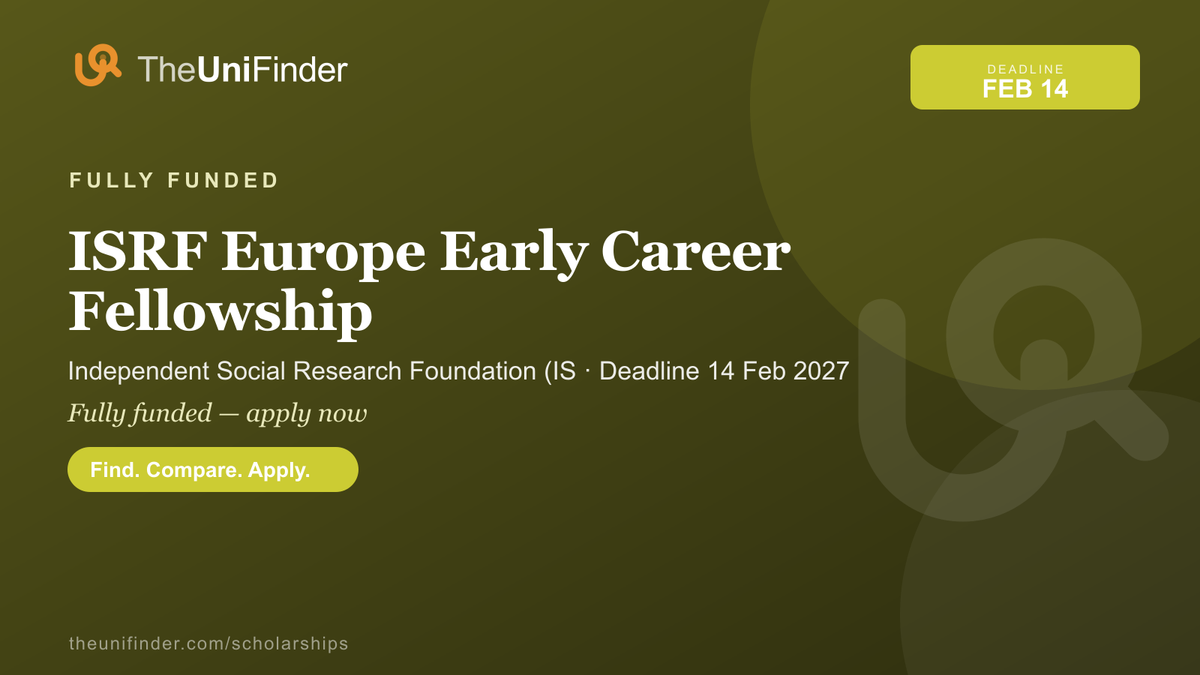
ISRF Europe Early Career Fellowship
Open to early-career researchers in the social sciences and humanities who are within 10 years of their PhD award (career breaks considered) and hold a salaried position at a higher education or research institution, or are independent scholars with a host institution. Research must be hosted at a European institution and address innovative, interdisciplinary social research questions. Open to scholars of all nationalities.
full
Funding
€82k
Max
Feb 14, 2027
Deadline
Frequently asked questions
What are the approximate tuition fees for international students at Quaid-i-Azam University?
+
International students can expect annual tuition fees ranging from approximately PKR 150,000 to 400,000 (around EUR 500–1,500). These fees vary by programme and faculty, and are generally double the domestic rate plus applicable levies.
What are the estimated living costs for students in Islamabad?
+
Islamabad is considered an affordable city for students. Monthly living expenses, including accommodation, food, and transport, are estimated to be between PKR 25,000 and 40,000 (approximately EUR 90–145).
What academic qualifications are required for international applicants?
+
International students typically need to provide certified academic transcripts and a valid passport copy. For Bachelor's and Master's programmes, a SAT I or the university's admission test is required. PhD applicants need a research concept proposal.
Does Quaid-i-Azam University offer scholarships for international students?
+
Yes, Quaid-i-Azam University offers various scholarships, including HEC Need & Merit Based Scholarships, Ehsaas Undergraduate Scholarship, and USAID Need & Merit Based Scholarships. There are also specific HEC Fellowships for MPhil and PhD research students.
How can international students demonstrate English proficiency?
+
International applicants from non-English-medium backgrounds can demonstrate English proficiency through an IELTS Academic score of at least 6.0 overall or a TOEFL iBT score of at least 79 for most programmes. Prior education from an English-medium institution is also accepted.
Last updated