UNITED STATES · NEW LONDON
United States Coast Guard Academy
public · Founded 1876 · Languages: en
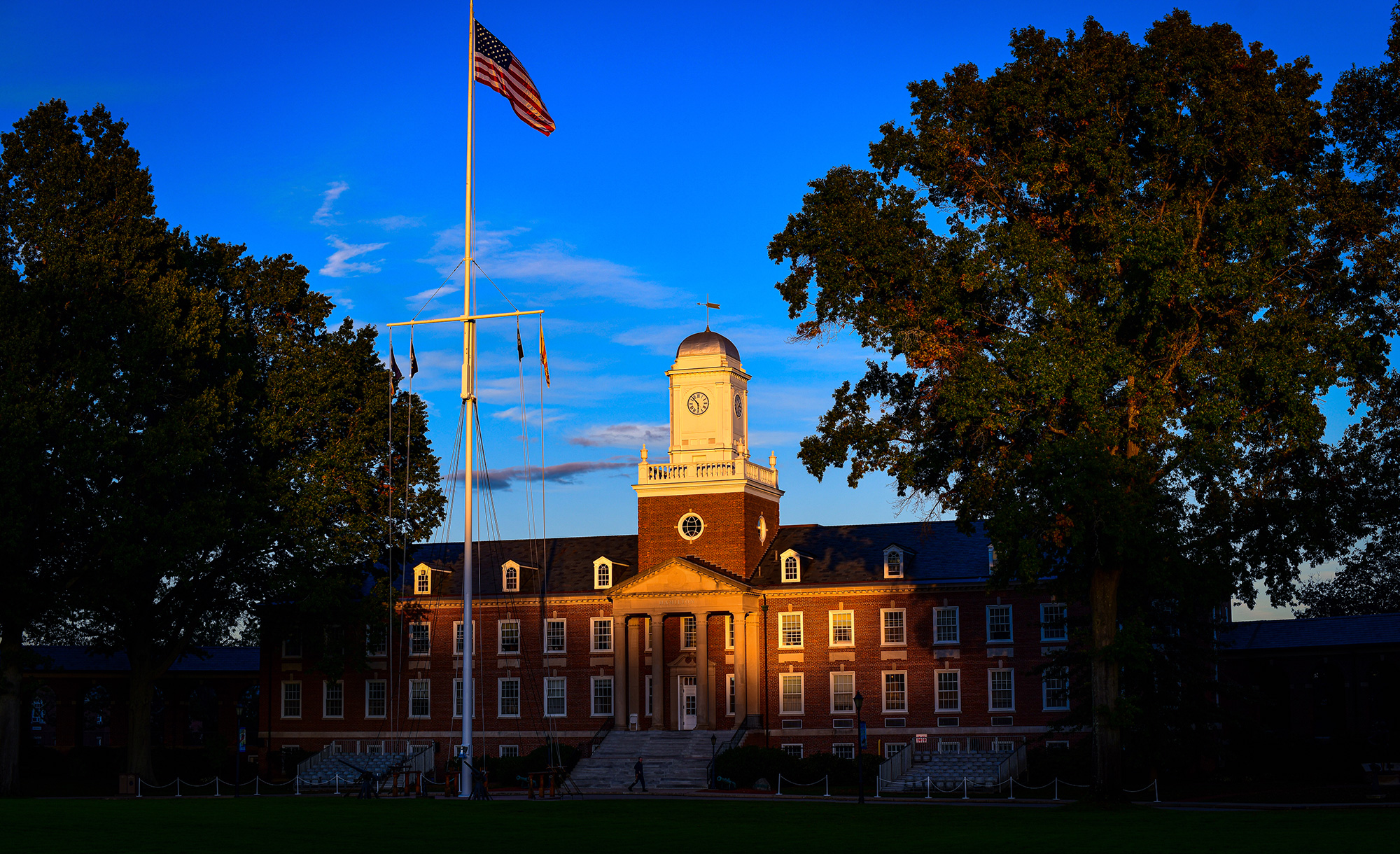
In short
The United States Coast Guard Academy in New London, Connecticut, offers a fully funded Bachelor of Science education for aspiring Coast Guard officers. Cadets receive tuition, room, board, and a stipend in exchange for a service commitment.
Key facts
- Type
- Public
- Founded
- 1876
- Students
- 1,000
- International students
- 20
- Acceptance rate
- 8%
- Languages
- EN
- Location
- New London, United States
The United States Coast Guard Academy (USCGA) is a highly selective federal service academy in New London, Connecticut, dedicated to commissioning officers for the U.S. Coast Guard. Established in 1876, it is the smallest of the five U.S. service academies, admitting approximately 300 cadets annually through a merit-based process that requires no Congressional nomination. Cadets receive a fully funded education — no tuition plus a monthly stipend — in exchange for a five-year active-duty commitment after graduation. The Academy offers ten Bachelor of Science degrees spanning STEM disciplines, maritime engineering, and social sciences, taught by civilian professors and active-duty officers at a 7:1 student-to-faculty ratio.
Why study here
- Fully funded education with no tuition and a monthly salary — no Congressional nomination required.
- Guaranteed leadership career commissioned as a U.S. Coast Guard Ensign upon graduation.
- Top-ranked STEM programs including Naval Architecture, Cyber Systems, and Marine Sciences.
- Exceptional 7:1 student-to-faculty ratio ensuring close mentorship and personal development.
- Professional training cruises, flight school opportunities, and hands-on maritime experience.
Student life
Cadet life at USCGA is structured and demanding, emphasising discipline, teamwork, and leadership. Over 62 percent of cadets compete on varsity athletic teams, and more than 65 clubs and organisations — from aviation to glee club — enrich campus life. The intensive Swab Summer initiation builds foundational military skills and lasting camaraderie. Annual training cruises aboard Coast Guard cutters provide invaluable at-sea experience before commissioning.
Fees
InternationalCadets, including international cadets, do not pay tuition. They receive a monthly salary (~$1,100) and full benefits in exchange for a five-year service commitment.
HomeCadets, including domestic cadets, do not pay tuition. They receive a monthly salary (~$1,100) and full benefits in exchange for a five-year service commitment.
LivingRoom and board are provided on-campus at no direct cost to cadets.
The optional Academy Introduction Mission (AIM) summer programme costs $750 for in-person attendance; virtual is free. No Congressional nomination is required for admission.
Admissions
Age17–23 years old at time of entry
CitizenshipU.S. citizen (limited slots for international cadets by treaty)
Academic recordStrong GPA and competitive SAT/ACT scores; median SAT ~1250–1350
LeadershipDemonstrated athletic participation and leadership experience
Medical/PhysicalMust pass DOD medical and physical fitness standards
CharacterHigh moral character; background investigation required
SAT/ACTRequired for all applicants; used as part of holistic academic review
Rankings
U.S. News Best Colleges – Liberal Arts CollegesTop 20 (periodically ranked)
Princeton Review – Best Value CollegesConsistently listed
University scholarships
Full Tuition Waiver + Monthly Stipend~$1,100/month plus room, board, and medical — all four years
Truman ScholarshipUp to $30,000 — merit award open to cadets demonstrating public-service commitment
Accreditation
USCGA is accredited by the New England Commission of Higher Education (NECHE). Engineering programs are accredited by ABET. The Cyber Systems major has pursued ABET accreditation.
For international students
United StatesStudent visa & funds
International students primarily enter on the F-1 visa, which requires enrolment at a SEVP-certified institution. Before the visa interview the school issues a Form I-20 — a certificate of eligibility — for which a Designated School Official must verify documented funds covering tuition, living expenses and travel for the first year, plus a reliable source for subsequent years. The financial evidence must be specific and from an identified source.
Working while you study
F-1 students may work on campus up to 20 hours per week while classes are in session and full-time during official breaks, with no separate authorization needed. Off-campus work is generally not permitted in the first academic year. After one academic year in good standing, students may use Curricular Practical Training (CPT) for paid work that is an integral part of the curriculum, authorized by the school; other off-campus work requires an approved Employment Authorization Document from USCIS.
After you graduate
After completing a degree, F-1 students may apply for Optional Practical Training (OPT) — up to 12 months of work authorization in a related field — by filing Form I-765 and receiving an EAD before starting work. Graduates of a degree on the DHS STEM Designated Degree Program List may apply for a 24-month STEM OPT extension, for up to 36 months total. The extension requires an E-Verify employer and a qualifying STEM degree earned within the previous ten years.
English tests
- IELTSUG 6.0–6.5; PG 6.5–7.0; top-tier programs 7.0–7.5
- TOEFL iBTUG 80–100; PG 90–110; selective research universities 100+
- PTE AcademicUG 50–60; PG 55–70; highly selective programs 65+
Main intakes
AugustJanuary
Typical living cost
€1,420/month
Approximate all-in student budget; major cities run higher.
SourcesStudy in the States — Students and the Form I-20 · Study in the States — Financial ability · USCIS — Students and employment · USCIS — Optional Practical Training (OPT) for F-1 students · USCIS — STEM OPT extension · LeapScholar — Minimum IELTS scores for USA universities · Mastersportal — Student living costs in the USA (2025–2026)
Programs
a selectionUnited States Coast Guard Academy · United States
Civil Engineering
The Civil Engineering program at the United States Coast Guard Academy (USCGA) offers a comprehensive education in the diverse fields of structural, construction, environmental, and geotechnical engineering. This program is designed for individuals with a broad range of interests who are seeking a challenging and rewarding career. Students gain a strong foundation in mathematics and engineering sciences, with opportunities for in-depth study in specialized areas. The curriculum emphasizes hands-on learning and practical application, preparing graduates for leadership roles in civil engineering within the Coast Guard and beyond.
Bachelor's
Level
Free
Tuition
48 mo
Duration
United States Coast Guard Academy · United States
Civil Engineering
Bachelor's
Level
—
Tuition
—
Duration
United States Coast Guard Academy · United States
Cyber Systems, Bachelor of Science
The Cyber Systems major provides a robust technical foundation in computing, emphasizing managerial aspects of cybersecurity. This interdisciplinary program aims to equip students with the skills needed to address the cyber challenges facing the U.S. Coast Guard and the nation. Graduates will be prepared to develop and implement advanced cyber technologies for operational missions, defend government cyber systems, protect critical infrastructure, manage information technology, and design secure software and networks.
Bachelor's
Level
Free
Tuition
—
Duration
United States Coast Guard Academy · United States
Electrical Engineering (B.S.E.E.)
The Electrical Engineering (EE) major at the United States Coast Guard Academy equips future officers with the knowledge and skills to develop and implement cutting-edge technologies. This program fosters critical thinking, enabling graduates to use computer systems and analytical methods to solve complex technical challenges. The curriculum emphasizes a systems approach and computer fluency. Key areas of focus include autonomy and robotics, communications and signal processing, cyber security, and energy systems. Graduates are prepared for diverse roles within the Coast Guard, leveraging advanced technology to address operational needs.
Bachelor's
Level
Free
Tuition
48 mo
Duration
United States Coast Guard Academy · United States
Geospatial Intelligence (GEOINT) Certificate Program
The United States Coast Guard Academy now offers an accredited Geospatial Intelligence (GEOINT) Certificate Program. This program prepares cadets to use geospatial information for strategic planning and decision-making in Coast Guard operations. Graduates with this certificate will possess valuable skills in analyzing imagery and data to identify patterns and solve complex problems relevant to national security and maritime operations.
Certificate
Level
—
Tuition
—
Duration
United States Coast Guard Academy · United States
Interdisciplinary Engineering
The Interdisciplinary Engineering major is designed to prepare future officers for diverse roles within the Coast Guard. This program offers a broad engineering background by integrating multiple disciplines, enabling graduates to work in various engineering fields. It also provides a solid foundation for a wide range of Coast Guard and civilian career paths. Students have the flexibility to tailor their course of study to their specific interests, working closely with an academic advisor. The program culminates in a senior-level capstone course sequence where students design an engineering system to meet specific Coast Guard needs. Graduates are well-prepared to pursue licensure as Professional Engineers and to undertake graduate studies in engineering or other disciplines.
Bachelor's
Level
Free
Tuition
—
Duration
Scholarships
for United States full funding
Duke University
Karsh International Scholarship Program
Open to international (non-U.S. citizen, non-permanent-resident) high school students applying for first-year undergraduate admission to Duke University. Candidates must demonstrate financial need through Duke's need-based aid process, show interdisciplinary academic curiosity, and have a record of community engagement. There is no separate scholarship form; international applicants who indicate they are applying for financial aid are automatically considered for the Karsh award.
full
Funding
€320k
Max
Jan 2, 2027
Deadline
 full funding
University of Miami (with the Stamps Family Charitable Foundation)
University of Miami Stamps Scholarship
Open to high school seniors, both domestic (U.S.) and international, applying for first-year undergraduate admission to the University of Miami through Early Decision I or Early Action. Applicants are automatically considered with no separate scholarship form; they must submit all first-year admission requirements and demonstrate strong academic achievement, leadership, and community involvement. Semi-finalists complete a Zoom interview.
full
Funding
€260k
Max
Nov 1, 2026
Deadline
 full funding
QuestBridge
QuestBridge National College Match Scholarship
Open to high-achieving US high school seniors from low-income backgrounds who are US citizens, permanent residents, or students studying in the US regardless of citizenship. Competitive applicants typically earn mostly A's in challenging courses, rank in the top 5-10% of their class, and have strong standardised test results (SAT/PSAT above 1310 or ACT above 28), though each application is read in context. Applicants must demonstrate strong writing, intellectual curiosity and determination through essays and recommendations. Matched students must attend a partner college as a binding-early-decision commitment.
full
Funding
€185k
Max
10d left
Deadline
full fundingArgonne National Laboratory
Maria Goeppert Mayer Fellowship at Argonne National Laboratory
Open to early-career scientists and engineers of all nationalities who hold a PhD awarded within the last three years at the time of application, or who will complete the PhD before the fellowship start date. Research interests must align with Argonne's mission areas. U.S. citizenship is required for national-security-related projects (Detection of Imaging Signatures).
full
Funding
€130k
Max
15d left
Deadline
 partial funding
Boustany Foundation / Harvard Business School
Boustany MBA Harvard Scholarship
Open to candidates of any nationality (priority to those of Lebanese descent) who have received an offer of admission to the Harvard MBA programme and have a strong academic background.
partial
Funding
€100k
Max
May 31, 2027
Deadline
 full funding
Stanford University
Knight-Hennessy Scholars
Open to citizens of any country who earned their first/bachelor's degree within the last ~7 years (or will by the Stanford start) and who apply for and gain admission to a full-time Stanford graduate program. Selection seeks independence of thought, purposeful leadership, and a civic mindset.
full
Funding
€90k
Max
22d left
Deadline
Frequently asked questions
Does the United States Coast Guard Academy (USCGA) offer a fully funded education?
+
Yes, USCGA provides a fully funded education for all cadets. This includes no tuition costs, a monthly stipend, and full benefits in exchange for a five-year service commitment after graduation.
Are there any fees for admitted cadets at USCGA?
+
Admitted cadets do not pay tuition, and room and board are provided on campus at no direct cost. The optional Academy Introduction Mission (AIM) summer program has a $750 fee for in-person attendance, while the virtual option is free.
Can international students attend the United States Coast Guard Academy?
+
Yes, international cadets can attend USCGA, though slots are limited and available through treaty agreements. Like domestic cadets, they receive a fully funded education and monthly salary in exchange for a service commitment.
What are the benefits of studying at the United States Coast Guard Academy?
+
Benefits include a fully funded education with a monthly salary, guaranteed leadership career as a U.S. Coast Guard Ensign, top-ranked STEM programs, a low student-to-faculty ratio, and extensive hands-on maritime and professional training experiences.
What academic programs are available at USCGA?
+
The Academy offers ten Bachelor of Science degrees covering STEM disciplines, maritime engineering, and social sciences. Prominent programs include Naval Architecture, Cyber Systems, and Marine Sciences.
Last updated