CHINA · BEIJING
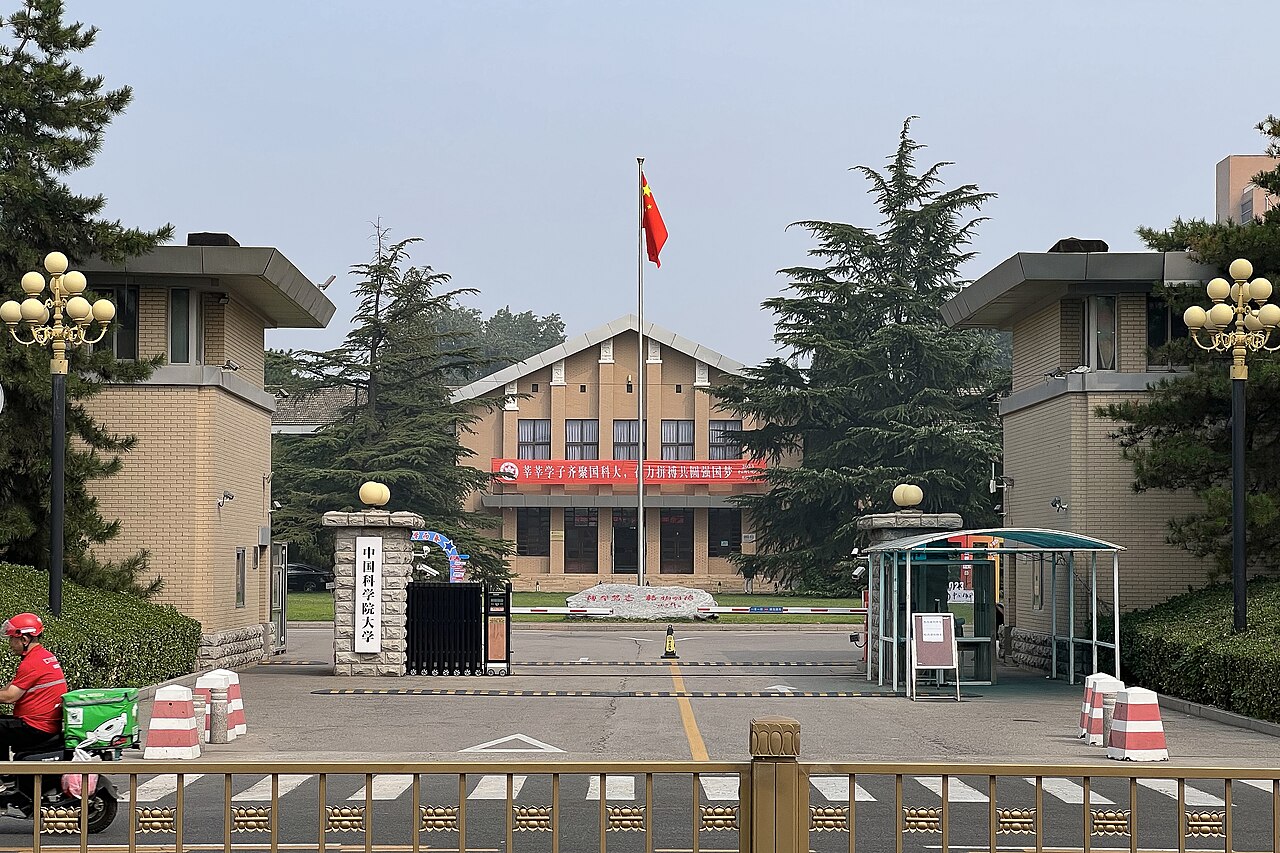
University of the Chinese Academy of Sciences
public · Founded 1978 · Languages: en, zh
In short
The University of Chinese Academy of Sciences (UCAS) is a leading research-intensive university in China, offering graduate programs with a strong emphasis on scientific research and practical experience. It leverages extensive resources from the Chinese Academy of Sciences and provides significant opportunities for international students through various scholarships and global collaborations.
Key facts
- Type
- Public
- Founded
- 1978
- Students
- 53,000
- International students
- 1,937
- Acceptance rate
- 12%
- Tuition (intl)
- €4–5k/yr
- Languages
- EN, ZH
- Location
- Beijing, China
The University of Chinese Academy of Sciences (UCAS) is a prominent research-intensive university in China, primarily focused on graduate education while also offering a distinguished undergraduate program. Established through the Chinese Academy of Sciences (CAS), UCAS integrates scientific research with education, leveraging the extensive resources of over 100 CAS institutes nationwide. UCAS is dedicated to cultivating future leading scientists through an innovative educational approach. The university emphasizes practical experience and individualized learning, particularly for undergraduates, by implementing a unique "three-phase" education system and an academic tutor system that connects students with high-caliber researchers. With campuses and educational centers both within and outside Beijing, UCAS provides a vast and dynamic environment for scientific exploration. As of 2024, UCAS hosts 1937 international students from 96 countries, with doctoral students forming a significant majority. The university offers a wide array of disciplines, spanning philosophy, economics, law, education, literature, history, science, engineering, agriculture, medicine, management, and interdisciplinary sciences, providing comprehensive opportunities for advanced study and research.
Why study here
- Access to high-level research advantages and resources from the Chinese Academy of Sciences (CAS), including 5 National Laboratories and numerous State Key and CAS Key Laboratories.
- Benefit from an integrated science and education model, fostering talented and highly qualified students across diverse backgrounds.
- Experience individualized education with a strong emphasis on practice, supported by an academic tutor system that connects students with leading scientists.
- Opportunity for international exposure through a credit system that allows a semester of study and research at well-recognized overseas universities or institutes.
- Engage in cutting-edge research, exemplified by breakthroughs like the first observation of CP violation in baryon decays, with significant contributions from UCAS research teams.
Student life
Student life at UCAS is deeply intertwined with scientific research and academic development. Undergraduate students benefit from a 'three-phase' education system that allows flexibility in major choice and research focus, including an opportunity for a semester of study abroad. The university fosters an environment of active thinking and inquiry through small class sizes and seminar-style teaching. Beyond academics, UCAS offers various activities, including sports, cultural events, and academic seminars featuring distinguished speakers. The university also manages field observation and research stations, like the Yanshan Station, which serve as bases for experimental teaching, field internships, and interdisciplinary scientific research, allowing students to engage directly in environmental and ecological studies relevant to the Beijing-Tianjin-Hebei region.
Fees
InternationalMaster's programs: RMB 30,000/year. Doctoral programs: RMB 40,000/year. Application fee: RMB 600.
Home—
LivingAccommodation in UCAS Beijing campus is generally free for scholarship recipients, or a subsidy of up to RMB 700/month for master's students and RMB 1000/month for doctoral students may be provided for off-campus living. For CAS institutes outside Beijing, basic accommodation is provided during concentrated study at UCAS, while host institutes assist with accommodation during research periods, with associated expenses paid by the awardees.
Medical insurance is RMB 800/year. These figures are for scholarship awardees; other students may have different arrangements.
Admissions
CitizenshipNon-Chinese citizens with a valid passport.
HealthGood character and health, without infectious, physical, or mental diseases affecting study.
Master's ProgramsBachelor's degree or equivalent (must be under 35 years old for Chinese Government Scholarship).
Doctoral ProgramsMaster's degree or equivalent (must be under 40 years old for Chinese Government Scholarship, born after Jan 1, 1991 for UCAS Scholarship).
Visiting Students (Regular)At least one year of undergraduate study.
Visiting Students (Senior)Master's or Doctoral degree, or equivalent.
IELTS6.0 or above for English-taught programs (program-dependent)
TOEFL80 or above for English-taught programs (program-dependent)
Rankings
QS World University Rankings362
University scholarships
UCAS Scholarship for International StudentsFull Scholarship covers tuition waiver (RMB 30,000-40,000/year), application fee waiver (RMB 600), monthly stipend (RMB 2,000 for Master's, RMB 2,500 for PhD, plus research assistantship from supervisor/institute, totaling no less than RMB 3,000/month for Master's and RMB 3,500/month for PhD), basic accommodation, and medical insurance (RMB 800/year). Partial Scholarship covers tuition waiver, medical insurance, and application fee.
CAS-ANSO Scholarship (Degree Program)Full scholarship covering tuition waiver, monthly stipend (RMB 3,000 for Master's, RMB 6,000-7,000 for PhD), health insurance, application fee, and international travel allowance for eligible applicants (one economy class flight from home country to China, and one from China to home country).
Chinese Government ScholarshipFull scholarship covering tuition fee waiver (RMB 30,000/year for Master's, RMB 40,000/year for PhD), application fee waiver (RMB 600), monthly stipend (RMB 3,500 for Master's, RMB 5,000 for PhD, including contributions from supervisor/institute), accommodation fee waiver or subsidy (up to RMB 700/month for Master's, RMB 1,000/month for PhD), and medical insurance (RMB 800/person).
Accreditation
UCAS is a state-recognized public university authorized by China's Ministry of Education to award bachelor's, master's and doctoral degrees, and is part of the national Double First-Class Construction initiative.
Programs
a selectionUniversity of the Chinese Academy of Sciences · China
Master's and Doctoral Degree Programs for International Students
The University of Chinese Academy of Sciences (UCAS) offers Master's and PhD programs for international students, integrating science and education with a focus on graduate studies. With over 20 faculties and 100 institutes across China, UCAS provides a diverse range of disciplines including science, engineering, medicine, and humanities. Programs are available in both English and Chinese, with a standard duration of 3 years for Master's and 3-4 years for PhD degrees.
Master's
Level
—
Tuition
36 mo
Duration
University of the Chinese Academy of Sciences · China
Principles of Computer Organization
This is a core compulsory course for Computer Science and Technology majors, playing a crucial role in undergraduate education. It aims to provide students with a deep understanding of the internal workings, hardware organization, and implementation technologies of modern digital computer systems. Upon completion, students will grasp the mechanisms of software-hardware interaction, develop a comprehensive system-level concept, and enhance their computer system capabilities. The course is essential for cultivating students' abilities in understanding, designing, developing, and applying computer systems, fostering advanced thinking skills.
Bachelor's
Level
—
Tuition
—
Duration
University of the Chinese Academy of Sciences · China
T. D. Lee Lectures
The T. D. Lee Lectures are a series of advanced talks established in honor of the Nobel laureate Tsung-Dao Lee, who initiated the China-U.S. Physics Examination and Application (CUSPEA) program. This program enabled many Chinese students to pursue doctoral studies in physics in the United States. The lectures aim to provide students with insights into cutting-edge research across various scientific frontiers, complementing their foundational coursework and facilitating their entry into advanced research fields. These lectures are delivered annually during the summer term by distinguished scholars actively working at the forefront of science, both internationally and within China. The curriculum covers a wide range of topics, including theoretical physics, particle physics, nanophysics, condensed matter physics, and biophysics. The series also explores the intersection of science and art, reflecting a holistic approach to scientific inquiry. The program encourages students to engage with new research findings and foster a spirit of innovation. It aims to inspire young scientists to achieve excellence and contribute to scientific advancement, carrying forward the legacy of T. D. Lee's contributions to physics and education.
Master's
Level
—
Tuition
—
Duration
University of the Chinese Academy of Sciences · China
University of the Chinese Academy of Sciences - International Admissions
The University of the Chinese Academy of Sciences (UCAS) has been admitting international students since 2004. It offers Master's and PhD programs, with a strong emphasis on graduate education. UCAS leverages the extensive research capabilities and resources of the Chinese Academy of Sciences (CAS), operating across multiple campuses in Beijing and numerous research institutes throughout China. This structure provides students with access to advanced research facilities and a wide network of experts. UCAS aims to cultivate leading scientists dedicated to scientific excellence and national service through innovative education. The university hosts a significant number of international students, reflecting its global reach and academic standing.
Master's
Level
—
Tuition
—
Duration
Scholarships
for China full funding
Tsinghua University
Schwarzman Scholars
Open to applicants of any nationality who hold (or will hold) a bachelor's degree by the programme start and are under ~29 years old at the deadline. English proficiency is required; Chinese is not. Selection seeks demonstrated leadership, academic strength, and the potential to bridge China and the world.
full
Funding
€65k
Max
28d left
Deadline
full fundingTsinghua University (sponsored by Siemens Ltd., China)
Siemens China Scholarship at Tsinghua University
International students who meet Tsinghua University's PhD admission requirements, hold a strong academic background in computer science, engineering or AI, apply to one of the approved Siemens research fields, and do not hold another major PhD scholarship at Tsinghua. Applicants should be willing to collaborate on industry-focused research with Siemens.
full
Funding
€22k
Max
Feb 28, 2027
Deadline
 full funding
China Scholarship Council (CSC), Ministry of Education, People's Republic of China
Chinese Government Scholarship (CSC)
Open to non-Chinese citizens in good health who meet the academic and age requirements for their level (under ~25 for bachelor's, ~35 for master's, ~40 for doctoral, as a guideline). Applicants apply via a Chinese university, a Chinese embassy, or another dispatching authority, depending on the programme.
full
Funding
€20k
Max
Apr 30, 2027
Deadline
full fundingTsinghua University / China Scholarship Council (CSC)
Tsinghua University Chinese Government Scholarship (CGS)
For non-Chinese citizens in good health who apply for a bachelor's, master's, or doctoral degree at Tsinghua University in Beijing. The Chinese Government Scholarship is administered by Tsinghua as a designated host university; applicants apply both to the China Scholarship Council (CSC) and for Tsinghua admission, and must meet the relevant age and academic requirements.
full
Funding
€15k
Max
Mar 1, 2027
Deadline
 full funding
Shanghai Jiao Tong University School of Medicine (SHSMU)
SJTU School of Medicine Chinese Government Scholarship
Open to non-Chinese citizens in good health who are not currently studying in China. Master's applicants must hold a bachelor's degree and be under 35; doctoral applicants must hold a master's degree and be under 40. Applicants must show excellent academic records and must not hold any other Chinese government or organisation scholarship.
full
Funding
€15k
Max
Apr 14, 2027
Deadline
 full funding
Shenzhen University (SZU)
Shenzhen University PhD Scholarships
Open to non-Chinese citizens with a valid foreign passport who hold a Master's degree or are in the final year of a Master's program, are in good physical and mental health, and are under 40 years old at the time of application. Applicants must meet language requirements (HSK 4 or 5 for Chinese-taught programs, or TOEFL/IELTS for English-taught programs) and should secure a prospective PhD supervisor at SZU before applying.
full
Funding
€14k
Max
May 15, 2027
Deadline
Frequently asked questions
What are the tuition fees for international students at the University of Chinese Academy of Sciences (UCAS)?
+
Master's programs are RMB 30,000 per year, and doctoral programs are RMB 40,000 per year. There is also an application fee of RMB 600. These figures are primarily for scholarship awardees, and other students may have different fee arrangements.
What are the English language proficiency requirements for international applicants?
+
For English-taught programs, applicants generally need an IELTS score of 6.0 or above, or a TOEFL score of 80 or above. Specific program requirements may vary.
What academic qualifications are needed for Master's and Doctoral programs?
+
For Master's programs, applicants need a Bachelor's degree or equivalent. For Doctoral programs, a Master's degree or equivalent is required. There are also age limits for scholarship applicants.
Does UCAS offer scholarships for international students?
+
Yes, UCAS offers several scholarships, including the UCAS Scholarship for International Students, the CAS-ANSO Scholarship, and the Chinese Government Scholarship. These can cover tuition, stipends, accommodation, and medical insurance.
Where is UCAS located and what is the campus environment like?
+
UCAS operates campuses in Beijing, including Yuquanlu, Zhongguancun, and Yanqihu, as well as education centers outside the capital. The Yanqihu campus, for example, is situated in a scenic mountainous area, offering a unique environment for research.
Last updated