NETHERLANDS · ENSCHEDE
University of Twente
public · Founded 1961 · Languages: en, nl, es, it, de
In short
The University of Twente is a top-ranked technical and social sciences research university in Enschede, Netherlands, known for its 'High Tech, Human Touch' approach and entrepreneurial spirit. It offers a diverse, English-friendly campus environment with competitive tuition fees and scholarships for international students.
Key facts
- Type
- Public
- Founded
- 1961
- Students
- 13,000
- International students
- 4,500
- Acceptance rate
- 55%
- Tuition (intl)
- €10–16k/yr
- Languages
- EN, NL, ES, IT, DE
- Location
- Enschede, Netherlands
The University of Twente (UT) is a public technical and social sciences research university in Enschede, Netherlands, founded in 1961. Ranked among the world's top 200 universities, UT is distinguished by its 'High Tech, Human Touch' ethos that integrates engineering, science, and social disciplines to address complex societal challenges. It is one of the Netherlands' most entrepreneurial universities, having spawned hundreds of start-ups through its Novel-T innovation ecosystem. The English-friendly campus attracts students from over 100 countries.
Why study here
- Top 200 globally (QS, THE) — one of the Netherlands' leading research universities
- Unique interdisciplinary approach combining high-tech science with social sciences
- Strong entrepreneurial culture: Novel-T ecosystem supports student and staff start-ups
- Guaranteed housing for non-EEA Bachelor's and Master's students in their first year
- Many programmes fully taught in English, with a large, welcoming international community
Student life
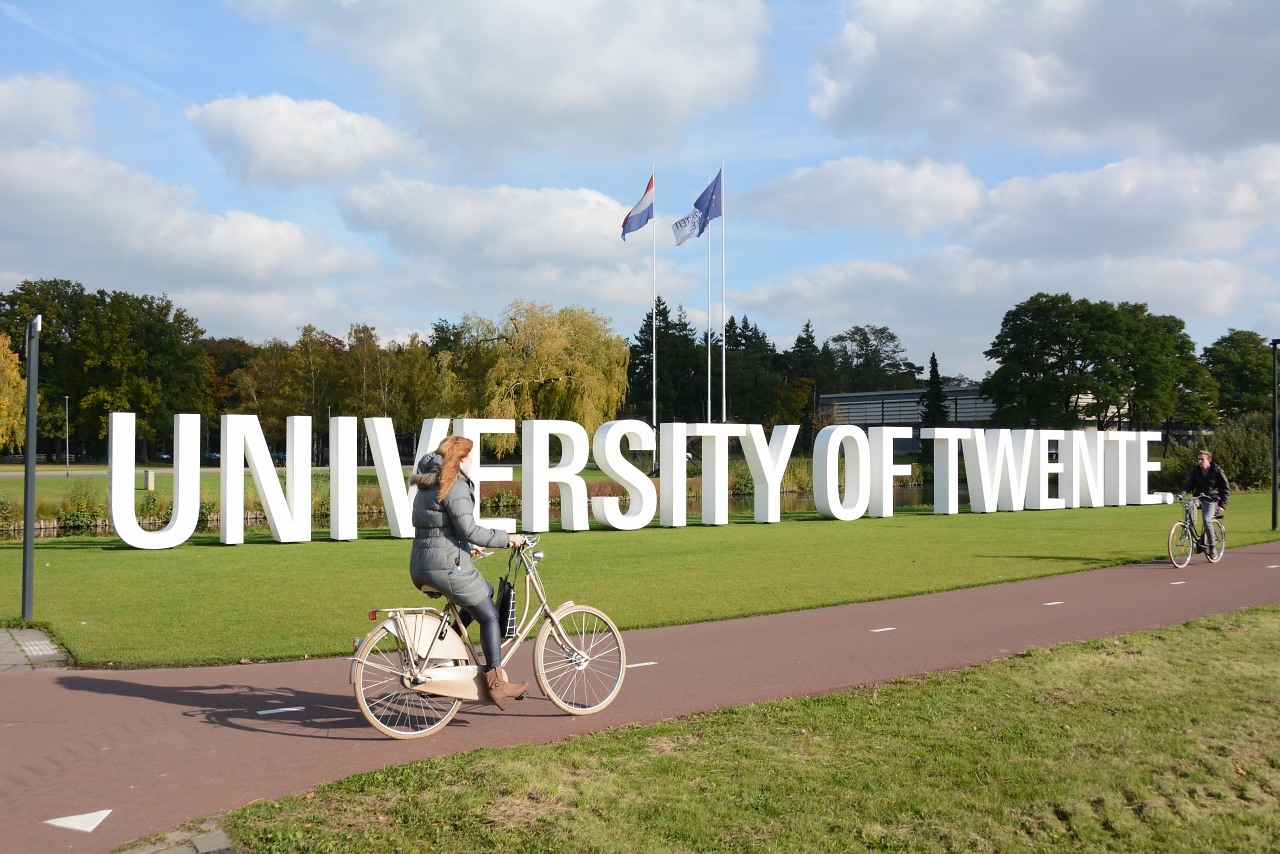
The University of Twente's compact green campus is home to all faculties, student housing, sports facilities, restaurants, and cultural venues — creating a genuine campus community. Student associations, sports clubs, and cultural organisations are abundant. Enschede itself is a lively mid-sized city with affordable living costs and good rail connections to Amsterdam, Utrecht, and Germany. The university's international office provides dedicated support for incoming students from abroad.
Fees
InternationalNon-EU/EEA Bachelor's students pay EUR 12,300–16,400 per year (2026–27) depending on programme. Master's programme fees for non-EU students typically range from EUR 15,000–20,000 per year.
HomeEU/EEA students pay the Dutch statutory tuition fee of approximately EUR 2,694 per year (2026–27).
LivingEnschede is one of the Netherlands' most affordable cities. Estimated living costs: EUR 800–1,100 per month (EUR 9,600–13,200 per year) including housing, food, and transport.
Tuition fees are set annually by the Dutch government (statutory fee) or UT (institutional fee for non-EU students). The University of Twente Scholarship (UTS) is available for excellent non-EU Master's students.
Admissions
Secondary education certificateRequired for Bachelor's admission; must be equivalent to Dutch VWO level
Bachelor's degreeRequired for Master's programmes; minimum GPA requirements vary by programme
Application feeEUR 100 for applicants with a non-Dutch degree
TOEFL iBTMinimum 80–90 depending on programme
IELTSMinimum 6.0–6.5 depending on programme
Rankings
QS World University Rankings162
Times Higher Education World University RankingsTop 200
U.S. News Best Global UniversitiesTop 200
University scholarships
University of Twente Scholarship (UTS)EUR 3,000–22,000 for one year (Master's, non-EU students)
Kipaji ScholarshipAdditional award on top of UTS for outstanding recipients
Holland ScholarshipEUR 5,000 one-time award for non-EEA students in their first year
Accreditation
UT is accredited by the NVAO (Accreditation Organisation of the Netherlands and Flanders). Individual programmes hold relevant professional accreditations including AACSB (Business) and ABET-equivalent NVAO recognition for Engineering.
For international students
NetherlandsStudent visa & funds
Non-EU students cannot apply for their own residence permit; only an IND-recognised institution (a registered sponsor) submits the application on their behalf. The permit is issued for up to five years and stays valid for three months after the programme ends. For university and HBO students the IND requires proof of at least €1,130.77 per month (the 2026 study norm) for living costs, held by the student or guaranteed by the institution. Students must also keep satisfactory progress — at least 50% of annual credits — to retain the permit.
Working while you study
Non-EU students may work a maximum of 16 hours per week during the academic year, or alternatively full-time during June, July and August. In either case the employer must first obtain a work permit (TWV) from the UWV before the student starts; the student cannot apply for it themselves. Internships that are a formal, graded part of the degree are exempt from the TWV requirement when a tri-party agreement is in place, as is volunteering with a Volunteer Declaration.
After you graduate
After a bachelor’s, master’s or PhD at a Dutch institution, non-EU graduates may apply for the orientation year permit (zoekjaar), valid for one year and not extendable. During this year the holder may work freely — no employer TWV is needed — and may also freelance or start a business. The application must be made within three years of graduating. Graduates of a foreign university ranked in the global top 200 can also qualify with English proficiency at IELTS 6.0 or equivalent.
English tests
- IELTS6.0–6.5 for bachelor’s; 6.5–7.0 for most master’s; specialist master’s up to 7.0–7.5
- TOEFL iBT80–90 for bachelor’s; 90–100 for master’s; some research universities require 100
Main intakes
SeptemberFebruary
Typical living cost
€1,200/month
Approximate all-in student budget; major cities run higher.
Programs
a selectionUniversity of Twente · Netherlands
Advanced Technology BSc
The Bachelor's in Advanced Technology at the University of Twente is a unique program for students interested in a broad range of science and engineering disciplines. Instead of focusing on a single field, this program allows you to explore various technical areas, building a personalized profile of expertise. You'll gain a comprehensive understanding of different technological fields, enabling you to connect and contribute across disciplines. This interdisciplinary approach is designed to equip you with versatile skills and a broad perspective, preparing you for diverse career paths.
Bachelor's
Level
—
Tuition
36 mo
Duration
University of Twente · Netherlands
Applied Mathematics
The Bachelor's in Applied Mathematics at the University of Twente focuses on using mathematical insights to solve complex, real-world problems. You will gain a strong theoretical foundation in mathematics while developing practical skills to model, analyze, and find solutions for societal challenges in areas like climate, traffic, economy, and healthcare. The program emphasizes the practical application of mathematics, equipping you to reduce complex issues to their mathematical essence. You'll explore how mathematics is integral to many fields and how to provide solutions across diverse domains. A significant aspect is the integration of Artificial Intelligence (AI), where you will learn about mathematical modeling, data analysis, and optimization techniques essential for understanding and improving AI systems, including hands-on experience with coding and neural networks. University of Twente promotes an interdisciplinary approach, encouraging collaboration with students and professionals from various fields, preparing you for diverse and international career paths. The program is known for its personal and informal learning environment, offering individual attention and support from lecturers, fostering both professional and personal growth.
Bachelor's
Level
—
Tuition
36 mo
Duration
University of Twente · Netherlands
Bachelor of Science in Creative Technology
The Bachelor's in Creative Technology (CreaTe) equips you to develop innovative, socially relevant tech solutions. You'll explore how technology, design, and human behaviour intersect to address societal challenges like energy, climate, and health. Through hands-on projects, you will gain technical expertise in areas like computer science and electrical engineering, while also learning to understand and shape the impact of technologies, including AI, on human interaction and decision-making. The program emphasizes a holistic approach, covering the entire creation process from identifying a problem to building and testing prototypes with users. You will also develop the ability to work across cultural and disciplinary boundaries, preparing you for a global career. The program offers flexibility in location, with options to study at the University of Twente (UT) in Enschede or in collaboration with Vrije Universiteit Amsterdam (VU). Whether in Enschede or Amsterdam, you will engage in project-based learning, utilize research labs, and receive personal attention from instructors. The informal learning environment encourages personal and professional growth, with opportunities to pursue extracurricular interests and even earn study credits for them.
Bachelor's
Level
—
Tuition
36 mo
Duration
University of Twente · Netherlands
Biomedical Technology
The Bachelor's programme in Biomedical Technology at the University of Twente focuses on developing technological innovations for the healthcare sector. You will learn to apply your knowledge of physics, mathematics, chemistry, biology, and medicine to create new technologies for medical care, such as advanced medical devices like rehabilitation robots, artificial kidneys, scans, and prosthetics. This program equips you to design and develop technologies that improve healthcare.
Bachelor's
Level
—
Tuition
36 mo
Duration
University of Twente · Netherlands
Business Information Technology
This Master's program focuses on combining business management principles with Information Technology (IT) to develop solutions for more effective, efficient, and future-proof organizations. You will learn to bridge the gap between business objectives and IT solutions, whether by designing effective architectures and processes, utilizing data for informed decision-making, or building robust security and resilience. The program aims to equip you with practical, scalable, and secure solution-building skills using real-world methods. It also prepares you for further research (PhD) or advanced innovation in the industry. The curriculum offers a balance between business and IT, providing insights into complex business processes and organizations, as well as in-depth knowledge of modern information systems and technologies. You will gain expertise in areas like IT architecture, IT-based business models, enterprise security, smart industry, data-driven decision support systems, and IT management.
Master's
Level
—
Tuition
24 mo
Duration
University of Twente · Netherlands
Civil Engineering and Management
The Civil Engineering and Management (CEM) Master's program at the University of Twente is designed to equip students with the knowledge and skills to address complex challenges in sustainable infrastructure. The program operates at the intersection of Civil Engineering, Social Sciences (including Public Administration, Management Science, Urban Planning, and Geography), and Data Science. Our mission is to develop innovative solutions for sustainable infrastructure, contributing to global Sustainable Development Goals such as clean water, affordable energy, and sustainable cities. We aim to prepare future engineers and scientists for leadership roles by integrating policy, planning, and technology to enhance resilience and drive sustainable transformations in our built and natural environments.
Master's
Level
—
Tuition
24 mo
Duration
Scholarships
for Netherlands full funding
Dutch Research Council (NWO)
NWO Rubicon Programme
For researchers who have recently completed (or are about to complete) a PhD, who want to gain research experience at a foreign institution (or at a Dutch institution if coming from abroad). It is a postdoctoral programme; applicants must have obtained their doctorate within the last ~12 months and apply through NWO with a host.
full
Funding
€180k
Max
Mar 31, 2027
Deadline
full fundingNuffic (Dutch Ministry of Foreign Affairs)
Orange Knowledge Programme (OKP) Scholarships
Open to mid-career professionals who are nationals of, and currently living and working in, one of the listed OKP partner countries. Applicants must have proficiency in English or French, be in work that aligns with one of the priority areas designated for their country, be able to show they will use and transfer their new knowledge within their employing organization, and agree to comply with the obligations and conditions of the OKP. A limited number of awards is granted to motivated female and male professionals.
full
Funding
€40k
Max
Mar 31, 2027
Deadline
 full funding
University of Groningen
Welcoming International Talent (WIT) PhD Fellowship
Open to Early-Stage Researchers of any nationality who, at the call deadline, have no more than four years of full-time-equivalent research experience and have not yet been awarded a doctoral degree. Applicants must hold a qualification that grants access to doctoral studies, meet the MSCA mobility rule (not having lived or worked in the host country for more than 12 months in the previous three years), and have at least certified B2-level English.
full
Funding
€32k
Max
Mar 18, 2027
Deadline
 full funding
Maastricht University
UM Brightlands Talent Scholarship
Open to non-EU/EEA and Swiss nationals under 35 who have conditional admission to a participating master's programme affiliated with a Brightlands campus, have not previously enrolled in Dutch higher education, and demonstrate strong academic performance.
full
Funding
€31k
Max
Feb 1, 2027
Deadline
full fundingMaastricht University
Maastricht University NL-High Potential Scholarship
Open to talented students from outside the EU/EEA, Switzerland and Suriname who have applied for admission to a participating full-time Master's programme at Maastricht University, meet the programme's admission requirements, have not previously studied for a degree in the Netherlands, and are no older than 35 on the cycle's start date.
full
Funding
€30k
Max
Feb 1, 2027
Deadline
 full funding
Delft University of Technology (TU Delft)
Justus & Louise van Effen Excellence Scholarship
For exceptional non-EU/EEA students applying for an MSc programme at Delft University of Technology (TU Delft) with an excellent academic record. The scholarship is merit-based and competitive; you apply for it after applying for admission to an eligible TU Delft master's, by the deadline (commonly 1 December).
full
Funding
€30k
Max
Dec 1, 2026
Deadline
Frequently asked questions
What are the tuition fees for international students at the University of Twente?
+
Non-EU/EEA Bachelor's students can expect tuition fees between EUR 12,300–16,400 per year for the 2026-27 academic year. Master's programme fees for non-EU students typically range from EUR 15,000–20,000 per year.
What are the estimated living costs for students in Enschede?
+
Enschede is considered one of the most affordable cities in the Netherlands. Estimated living costs, including housing, food, and transport, are between EUR 800–1,100 per month, or EUR 9,600–13,200 per year.
Does the University of Twente offer scholarships for international students?
+
Yes, the University of Twente offers several scholarships for international students. These include the University of Twente Scholarship (UTS) for excellent non-EU Master's students, the Kipaji Scholarship, and the Holland Scholarship.
What are the English language proficiency requirements for international students?
+
International students typically need a minimum TOEFL iBT score of 80–90 or an IELTS score of 6.0–6.5, depending on the specific programme.
What is the University of Twente's approach to education?
+
The University of Twente follows a 'High Tech, Human Touch' ethos, integrating engineering, science, and social disciplines to tackle complex societal challenges. It is also known for its strong entrepreneurial culture.
Last updated