UNITED STATES · CHARLOTTESVILLE
University of Virginia
public · Founded 1819 · Languages: en
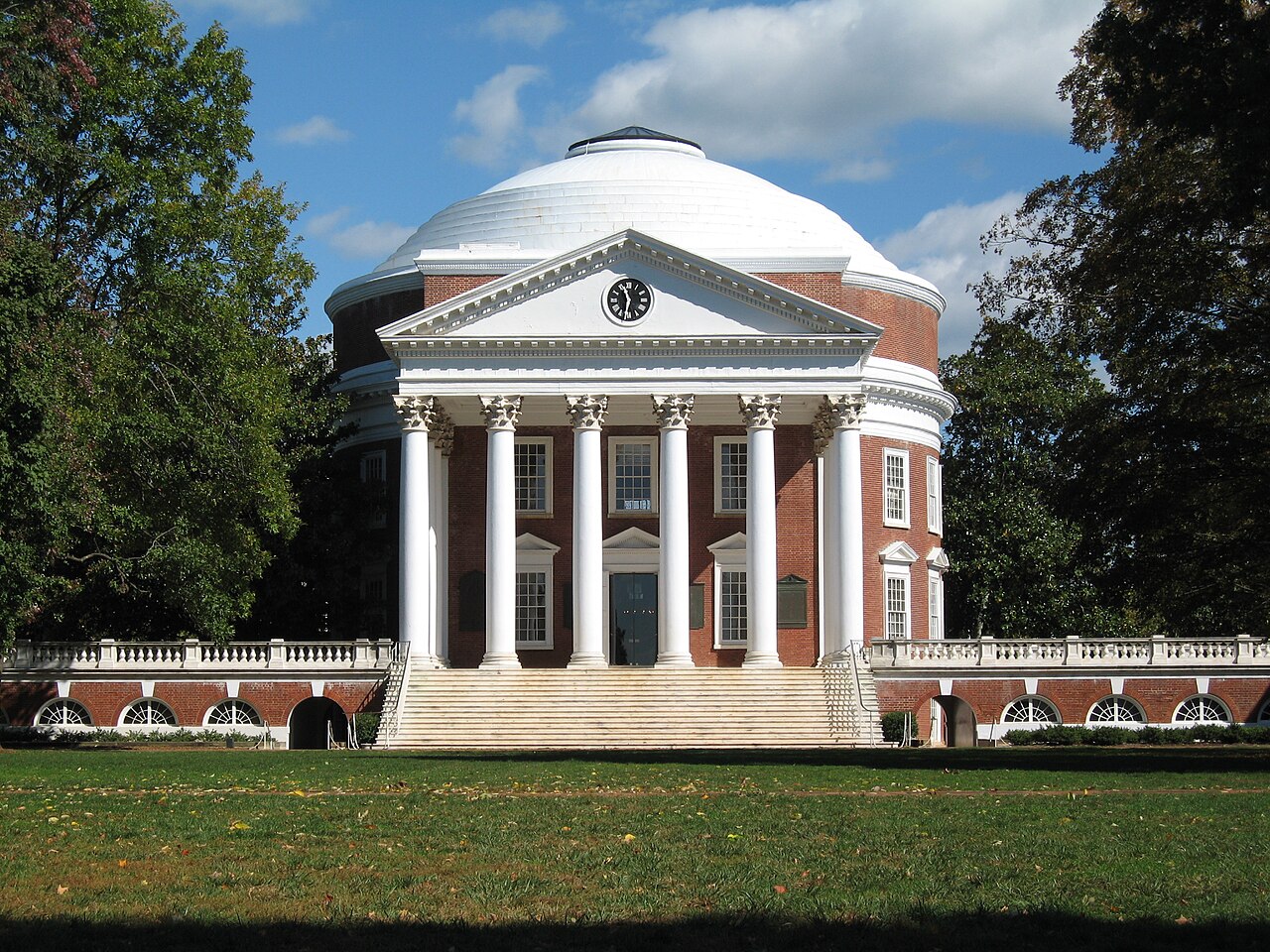
In short
The University of Virginia is a highly-ranked public institution in Charlottesville, Virginia, known for its academic excellence and value. It offers a wide range of programs and emphasizes a diverse, collaborative learning environment for its students.
Key facts
- Type
- Public
- Founded
- 1819
- Students
- 21,000
- International students
- 3,500
- Acceptance rate
- 20%
- Tuition (intl)
- €34–39k/yr
- Languages
- EN
- Location
- Charlottesville, United States
The University of Virginia (UVA) is a publicly funded institution in the United States, consistently recognized for its academic excellence and value. Founded in 1819, UVA is dedicated to advancing knowledge and preparing students to become engaged citizen leaders with a strong sense of empathy, integrity, and truth. The university offers a rich academic experience across its 12 schools, providing a wide array of undergraduate and graduate programs, majors, minors, degrees, and certificates. UVA emphasizes a collaborative learning environment where students are encouraged to explore their interests and pursue their passions. The university prides itself on fostering a vibrant intellectual community that benefits from diverse perspectives, including a significant international student population. With a commitment to accessibility, UVA aims to make world-class education achievable for qualified students. The institution is accredited by the Southern Association of Colleges and Schools Commission on Colleges (SACSCOC), ensuring adherence to high standards of educational quality and institutional effectiveness. Beyond academics, UVA focuses on student growth and community engagement, preparing graduates for successful careers and impactful contributions to society.
Why study here
- Access to a world-class education at a comparatively reasonable cost, consistently ranked for value.
- Comprehensive financial aid for eligible undergraduate students, meeting 100% of demonstrated need.
- A diverse and inclusive community that values global perspectives and encourages interdisciplinary study.
- Strong career prospects and high average starting salaries for graduates, supported by a vast alumni network.
- Opportunities to engage with world-class faculty and contribute to impactful research.
- A commitment to social responsibility, ethical leadership, and environmental sustainability, as exemplified by initiatives within schools like Darden.
Student life
Life at the University of Virginia is described as a fulfilling experience, blending academic rigor with a rich community atmosphere. Students are encouraged to engage in work and play, learning and growing, forming lasting relationships. UVA offers opportunities to join an uncommon community and participate in the evolving story of an iconic institution. Student organizations, social activities, and cultural events contribute to a dynamic and engaging environment. The Darden School of Business, for instance, highlights various student clubs focusing on energy, net impact, and social responsibility, emphasizing a balanced approach to academic and personal development.
Fees
InternationalThe University of Virginia does not have dedicated scholarships or loans for international students (foreign nationals), with the exception of those attending United World College schools. Prospective international students are advised to ensure they can finance their education.
HomeFor in-state undergraduates, UVA covers tuition, fees, room, and board for families with incomes under $50,000. Tuition and fees are covered for in-state undergraduates with family incomes under $100,000. Virginia families with incomes under $150,000 receive tuition grants of $2,000.
LivingHousing and dining options on Grounds are available separately from tuition and required fees. Further details are available via Housing and Residence Life and Dining Services websites.
Tuition and fee rates are subject to change by the Board of Visitors. The provided Post Bacc Pre-Med Program cost includes a comprehensive fee. Mandatory comprehensive fees are assessed for facilities and services, and Off-Grounds Fees ($12 per credit hour for credit courses, $12 per course for non-credit) apply to students in programs outside Charlottesville or in online courses.
Admissions
Undergraduate ApplicationSubmitted via Common App; no separate application for international students.
Graduate ApplicationSubmitted through the Graduate School of Arts & Sciences online application system (deadlines vary by program, e.g., December 15 for Economics PhD, January 15 for Mathematics and Sociology PhD).
Financial GuaranteeRequired for admitted international students (foreign nationals) to accept the offer of admission.
Letters of RecommendationTypically 2-3 for graduate programs.
Statement of PurposeRequired for most graduate applications.
TranscriptsUnofficial transcripts generally accepted for initial application.
Application Fee$85 for graduate programs ($80 for Architecture), with waivers available for U.S. citizens in certain circumstances and automatically for citizens of some countries. SCPS has waived application fees for certificate and degree programs through Fall 2026.
TOEFLMinimum 90 for Economics PhD (institutional code 5820 for GRE, B875 for TOEFL/IELTS).
IELTSMinimum average 7.0 for Economics PhD.
Cambridge C1 Advanced or C2 ProficiencyAccepted
Duolingo English Test (DET)Accepted
InitialView or Vericant evaluationStrongly encouraged for all non-native English speakers.
Rankings
U.S. News & World Report#2 Best Value Public University (2026)
Money Magazine4.5★ Rating (2024)
Princeton Review#4 Best Public University for Financial Aid (2025)
Bloomberg Businessweek#1 Best Public Business School (2024–25 for Darden School)
Time Magazine#3 for Producing Future Leaders, among Public Schools (2024)
Princeton Review#4 Best Career Placement, among Public Schools (2023)
University scholarships
United World College Students Need-Based ScholarshipNeed-based scholarship support
Economics PhD Funding Package$30,600 per year ($24,480 academic year, $6,120 summer)
Computational Biology PhD Funding100% funding (tuition, stipend, research expenses)
Mathematics PhD Funding—
Statistics PhD Funding Package$36,000 annually
Sociology PhD Funding Package$28,800 (10-month stipend/salary) + $7,200 (summer stipend)
Accreditation
The University of Virginia is accredited by the Southern Association of Colleges and Schools Commission on Colleges (SACSCOC) to award baccalaureate, master's, educational specialist, and doctoral degrees.
For international students
United StatesStudent visa & funds
International students primarily enter on the F-1 visa, which requires enrolment at a SEVP-certified institution. Before the visa interview the school issues a Form I-20 — a certificate of eligibility — for which a Designated School Official must verify documented funds covering tuition, living expenses and travel for the first year, plus a reliable source for subsequent years. The financial evidence must be specific and from an identified source.
Working while you study
F-1 students may work on campus up to 20 hours per week while classes are in session and full-time during official breaks, with no separate authorization needed. Off-campus work is generally not permitted in the first academic year. After one academic year in good standing, students may use Curricular Practical Training (CPT) for paid work that is an integral part of the curriculum, authorized by the school; other off-campus work requires an approved Employment Authorization Document from USCIS.
After you graduate
After completing a degree, F-1 students may apply for Optional Practical Training (OPT) — up to 12 months of work authorization in a related field — by filing Form I-765 and receiving an EAD before starting work. Graduates of a degree on the DHS STEM Designated Degree Program List may apply for a 24-month STEM OPT extension, for up to 36 months total. The extension requires an E-Verify employer and a qualifying STEM degree earned within the previous ten years.
English tests
- IELTSUG 6.0–6.5; PG 6.5–7.0; top-tier programs 7.0–7.5
- TOEFL iBTUG 80–100; PG 90–110; selective research universities 100+
- PTE AcademicUG 50–60; PG 55–70; highly selective programs 65+
Main intakes
AugustJanuary
Typical living cost
€1,420/month
Approximate all-in student budget; major cities run higher.
SourcesStudy in the States — Students and the Form I-20 · Study in the States — Financial ability · USCIS — Students and employment · USCIS — Optional Practical Training (OPT) for F-1 students · USCIS — STEM OPT extension · LeapScholar — Minimum IELTS scores for USA universities · Mastersportal — Student living costs in the USA (2025–2026)
Programs
a selectionUniversity of Virginia · United States
Academics at the University of Virginia
The University of Virginia offers a comprehensive academic experience across 12 distinct schools, providing a wide array of majors, minors, degrees, and certificates. Founded on the principle of student choice in coursework, UVA continues to foster intellectual curiosity and expand horizons. Students engage with world-class faculty in a rich academic environment, with opportunities for interdisciplinary study and research. The university emphasizes not only academic excellence but also affordability and value, aiming to make higher education accessible to talented students regardless of their financial background.
Bachelor's
Level
—
Tuition
—
Duration
University of Virginia · United States
Advising Boards of Directors (Public and Private Equity) Under Siege
This program, taught by experienced lecturer Peter Kaufman, focuses on advising boards of directors in challenging situations, particularly those involving public companies and private equity. It delves into the complexities of distressed M&A and restructuring, drawing on real-world expertise. The course aims to equip participants with the knowledge and strategies necessary to navigate difficult financial and operational scenarios.
Master's
Level
—
Tuition
—
Duration
University of Virginia · United States
B.S. in Electrical Engineering
The Bachelor of Science in Electrical Engineering (B.S. EE) program prepares students for successful careers as practitioners and innovators in electrical engineering and related fields. Graduates are equipped to analyze, design, and implement creative solutions for problems involving electrical and electronic devices and systems. The program emphasizes teamwork, clear communication, and responsible interaction with colleagues, clients, employers, and society. Students begin with a unifying foundation in electrical engineering, which is then combined with technical and unrestricted electives. These electives allow for specialization in various application areas such as digital systems, communications, microelectronics, and more. Course planning resources, including templates and prerequisite flowcharts, are available to help students tailor their academic path to their personal and professional goals.
Bachelor's
Level
—
Tuition
48 mo
Duration
University of Virginia · United States
Bachelor of Arts in Drama
The Department of Drama at the University of Virginia offers a Bachelor of Arts (BA) degree in Drama. This program requires 33 credit hours and is housed within the College of Arts & Sciences. Students will gain a comprehensive understanding of theatrical arts through a curriculum designed to foster creativity, critical thinking, and practical skills. Participation in production activities and enrollment in various classes are encouraged, even for students not officially majoring or minoring in Drama.
Bachelor's
Level
—
Tuition
48 mo
Duration
University of Virginia · United States
Bachelor of Interdisciplinary Studies (BIS)
The Bachelor of Interdisciplinary Studies (BIS) is designed for adults who wish to complete their undergraduate degree while balancing work and personal commitments. This program offers a flexible, liberal arts-based education that equips you with essential skills in critical thinking, communication, problem-solving, and analytical reasoning. You can choose a concentration from areas such as business, technology, healthcare management, or liberal arts. The degree requires 120 semester credits, with at least 60 credits completed at UVA. The program is structured to accommodate working adults, typically taking three to four years to complete by studying two courses per semester, but offers flexibility for faster completion.
Bachelor's
Level
—
Tuition
36 mo
Duration
University of Virginia · United States
Bachelor of Science (B.S.) in Statistics
The Bachelor of Science (B.S.) in Statistics at the University of Virginia provides students with a comprehensive understanding of statistical theory and its practical applications. In today's data-driven world, a strong grasp of data analysis and statistical methods is crucial across numerous fields. This program equips graduates with the skills to design studies, manage and analyze data, adapt statistical methods based on theoretical knowledge, and effectively communicate findings to diverse audiences. Graduates will be well-prepared for careers in various industries or for further study in graduate programs such as Master's or Ph.D. degrees in Statistics.
Bachelor's
Level
—
Tuition
—
Duration
Scholarships
for United States full funding
Duke University
Karsh International Scholarship Program
Open to international (non-U.S. citizen, non-permanent-resident) high school students applying for first-year undergraduate admission to Duke University. Candidates must demonstrate financial need through Duke's need-based aid process, show interdisciplinary academic curiosity, and have a record of community engagement. There is no separate scholarship form; international applicants who indicate they are applying for financial aid are automatically considered for the Karsh award.
full
Funding
€320k
Max
Jan 2, 2027
Deadline
 full funding
University of Miami (with the Stamps Family Charitable Foundation)
University of Miami Stamps Scholarship
Open to high school seniors, both domestic (U.S.) and international, applying for first-year undergraduate admission to the University of Miami through Early Decision I or Early Action. Applicants are automatically considered with no separate scholarship form; they must submit all first-year admission requirements and demonstrate strong academic achievement, leadership, and community involvement. Semi-finalists complete a Zoom interview.
full
Funding
€260k
Max
Nov 1, 2026
Deadline
 full funding
QuestBridge
QuestBridge National College Match Scholarship
Open to high-achieving US high school seniors from low-income backgrounds who are US citizens, permanent residents, or students studying in the US regardless of citizenship. Competitive applicants typically earn mostly A's in challenging courses, rank in the top 5-10% of their class, and have strong standardised test results (SAT/PSAT above 1310 or ACT above 28), though each application is read in context. Applicants must demonstrate strong writing, intellectual curiosity and determination through essays and recommendations. Matched students must attend a partner college as a binding-early-decision commitment.
full
Funding
€185k
Max
9d left
Deadline
full fundingArgonne National Laboratory
Maria Goeppert Mayer Fellowship at Argonne National Laboratory
Open to early-career scientists and engineers of all nationalities who hold a PhD awarded within the last three years at the time of application, or who will complete the PhD before the fellowship start date. Research interests must align with Argonne's mission areas. U.S. citizenship is required for national-security-related projects (Detection of Imaging Signatures).
full
Funding
€130k
Max
14d left
Deadline
 partial funding
Boustany Foundation / Harvard Business School
Boustany MBA Harvard Scholarship
Open to candidates of any nationality (priority to those of Lebanese descent) who have received an offer of admission to the Harvard MBA programme and have a strong academic background.
partial
Funding
€100k
Max
May 31, 2027
Deadline
 full funding
Stanford University
Knight-Hennessy Scholars
Open to citizens of any country who earned their first/bachelor's degree within the last ~7 years (or will by the Stanford start) and who apply for and gain admission to a full-time Stanford graduate program. Selection seeks independence of thought, purposeful leadership, and a civic mindset.
full
Funding
€90k
Max
21d left
Deadline
Frequently asked questions
What academic programs are available at the University of Virginia?
+
The University of Virginia offers a wide array of undergraduate and graduate programs across its 12 schools, including majors, minors, degrees, and certificates. The university is dedicated to advancing knowledge and preparing students for engaged leadership.
Does the University of Virginia offer financial aid or scholarships for international students?
+
The University of Virginia does not have dedicated scholarships or loans for international students, with the exception of those attending United World College schools. Prospective international students are advised to ensure they can finance their education.
What are the admission requirements for international students?
+
The application process for international students is the same as for domestic students, using the Common App for undergraduates. English language assessment is strongly encouraged for all applicants whose first language is not English.
Where is the University of Virginia located?
+
The University of Virginia is located in Charlottesville, Virginia, a city set against the backdrop of the Blue Ridge Mountains, offering a blend of historic charm and natural beauty.
What makes the University of Virginia a good choice for students?
+
UVA is recognized for its academic excellence and value, with a commitment to accessibility and fostering a diverse, collaborative learning environment. It offers strong career prospects and opportunities for community engagement.
Last updated