Master's in Civil Engineering in United States
There are 7 master's Civil Engineering programmes for international students across 7 universities in United States. Tuition ranges from €26k to €71k. Browse the full list below, compare entry requirements, and explore scholarships to fund your studies.

City & Regional Planning, MCP: Public & Private Development
The Master of City Planning (MCP) program at the University of Pennsylvania offers a core curriculum designed to equip students with essential planning skills and knowledge. This program provides a practical and cutting-edge approach to urban planning education, covering the legal and historical foundations of planning, methods for analyzing population and economic data, and understanding the spatial organization of cities. Graduates will be adept at identifying effective planning strategies for various contexts. The Public & Private Development concentration focuses on the entrepreneurial, design, and financing aspects of developing both for-profit and community-focused housing and commercial projects. Students will learn to create development proposals that balance tenant needs, market demands, and community benefits, while emphasizing economic, social, and environmental sustainability. This concentration also explores collaborative models between private developers and public entities, including cities, redevelopment agencies, non-profits, and community groups, to foster affordable housing and public-private partnerships. The skills acquired are highly transferable and valuable internationally, particularly in rapidly developing regions.

Master of Science (M.S.) and Master of Urban and Regional Planning (M.U.R.P.) Dual Degree
This dual degree program allows you to earn a Master of Science (M.S.) from the School for Environment and Sustainability and a Master of Urban and Regional Planning (M.U.R.P.) from the Taubman College of Architecture and Urban Planning. It's designed to equip you with the analytical skills, scientific knowledge, and understanding of socio-behavioral dynamics needed to become an effective practitioner in fields like environmental or land use planning, open space preservation, environmental policy, and environmental justice. The program integrates the requirements of both degrees, enabling you to complete them in three years with 75 credit hours instead of the 90 hours normally required if pursued separately. This is achieved by 'double-counting' 15 credit hours, meaning certain courses fulfill requirements for both degrees. You will need to meet all individual program requirements for both the M.S. and M.U.R.P. degrees.

Master of Science (MS) in Civil Engineering
The Master of Science (MS) in Civil Engineering is a thesis-based graduate program designed to provide students with advanced knowledge and research skills in the field. Graduates will possess a strong foundation in civil and environmental engineering principles, the ability to apply this knowledge to complex technical challenges, and the capacity to conduct independent research. The program emphasizes developing professional written and oral communication skills, preparing students for impactful careers or further doctoral studies. This program requires a minimum of 30 credit hours of graduate-level study, including coursework and thesis research. Students must maintain a minimum GPA of 3.00 and achieve a grade of B- or higher in core courses. The curriculum typically spans two academic years and an intervening summer, culminating in the defense of an original research thesis. Students interested in pursuing a PhD should be aware that an MS degree is not automatically awarded upon completion of PhD requirements without a satisfactory master's thesis.

Master of Science in Civil Engineering
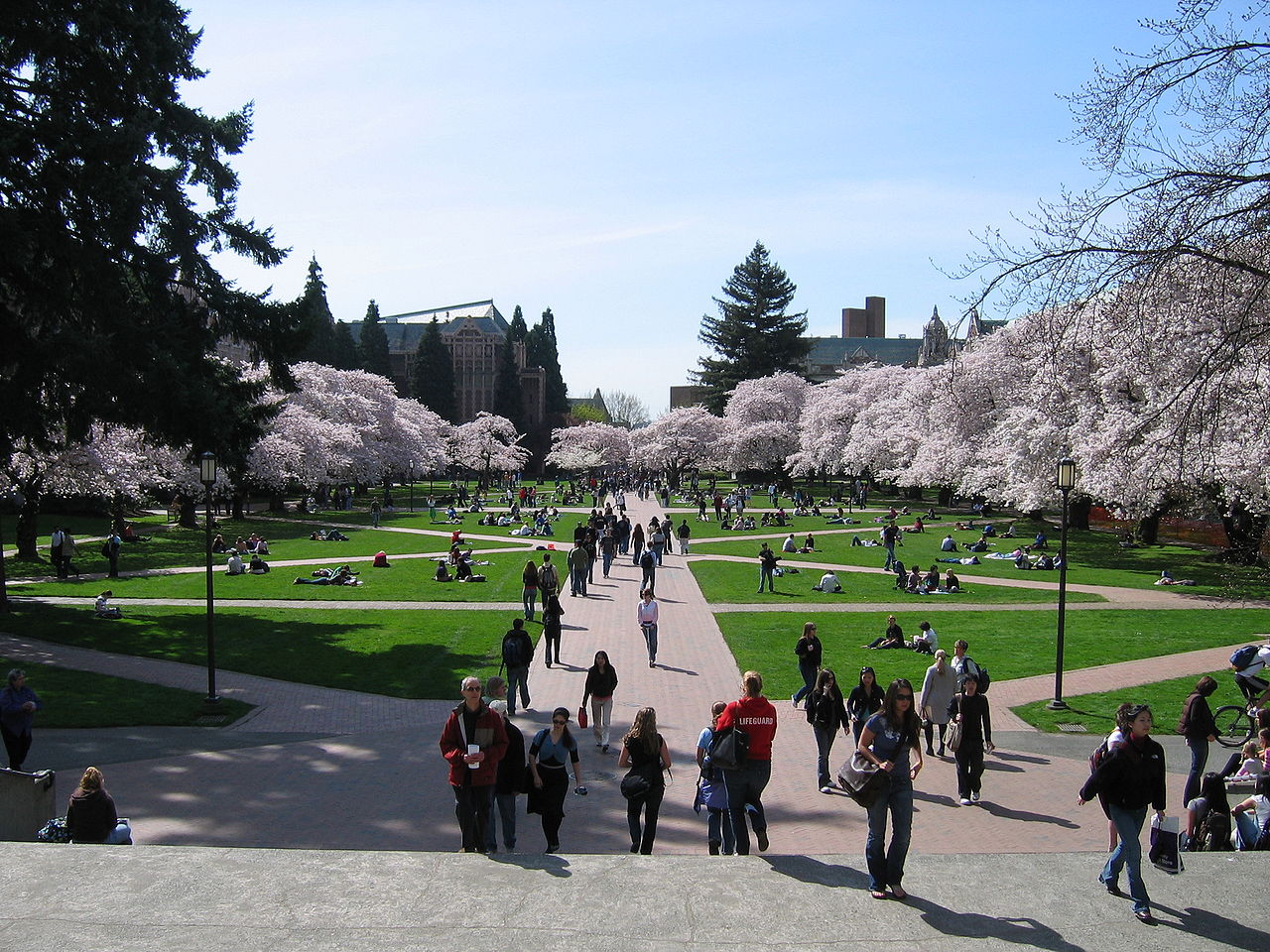
Master of Science in Civil Engineering - Environmental Engineering
The University of Washington offers a Master of Science (MS) in Civil Engineering with a specialization in Environmental Engineering. This program is designed to provide advanced knowledge and skills in environmental engineering, preparing graduates for leadership roles in research, industry, or public service. Students can choose between a research-focused thesis option or a coursework-only professional master's program. The curriculum emphasizes a strong foundation in core environmental engineering principles, including water quality, air quality, and environmental chemistry. Students have the flexibility to tailor their studies through elective courses, focusing on areas such as water treatment, air pollution control, environmental systems, and ecological engineering. The program encourages interdisciplinary learning, drawing on expertise from various departments across the university. Graduates of the Environmental Engineering MSCE program are well-equipped to address complex environmental challenges, contribute to sustainable development, and advance the field through innovative research and practical application.

Master of Science in Community and Regional Planning
The Master of Science in Community and Regional Planning program equips students with the knowledge and skills to address complex planning challenges. The curriculum includes foundational courses in planning history, theory, and ethics, quantitative and qualitative methods, sustainable land use, GIS, planning law, and public economics. Students will engage in an integrative planning studio and complete either a thesis or a professional report to synthesize their learning. The program allows for individual customization based on student interests, guided by a graduate advisor.

Structural Engineering
The Structural Engineering program focuses on the analysis and design of structures, preparing students for careers in structural engineering. It covers fundamental principles of mechanics, materials, and design, with a strong emphasis on problem-solving and the application of engineering knowledge to real-world challenges. Students will gain expertise in areas such as structural analysis, mechanics of deformable solids, and design of various structural systems.
Frequently asked questions
How many Civil Engineering programmes are there in United States?
+
7 across 7 universities, listed on this page.
Can international students apply?
+
Yes — these programmes admit international students; check each programme's entry requirements and language of instruction.