UNITED STATES · BRISTOL
King University
private · Founded 1867 · Languages: English
In short
King University is a private, Presbyterian-affiliated university in Bristol, Tennessee, founded in 1867. It offers over 90 areas of study with a strong emphasis on faith, scholarship, and community, boasting a 12:1 student-faculty ratio and significant financial aid opportunities.
Key facts
- Type
- Private
- Founded
- 1867
- Students
- 1,746
- International students
- 80
- Acceptance rate
- 62%
- Tuition (intl)
- €25–29k/yr
- Languages
- ENGLISH
- Location
- Bristol, United States
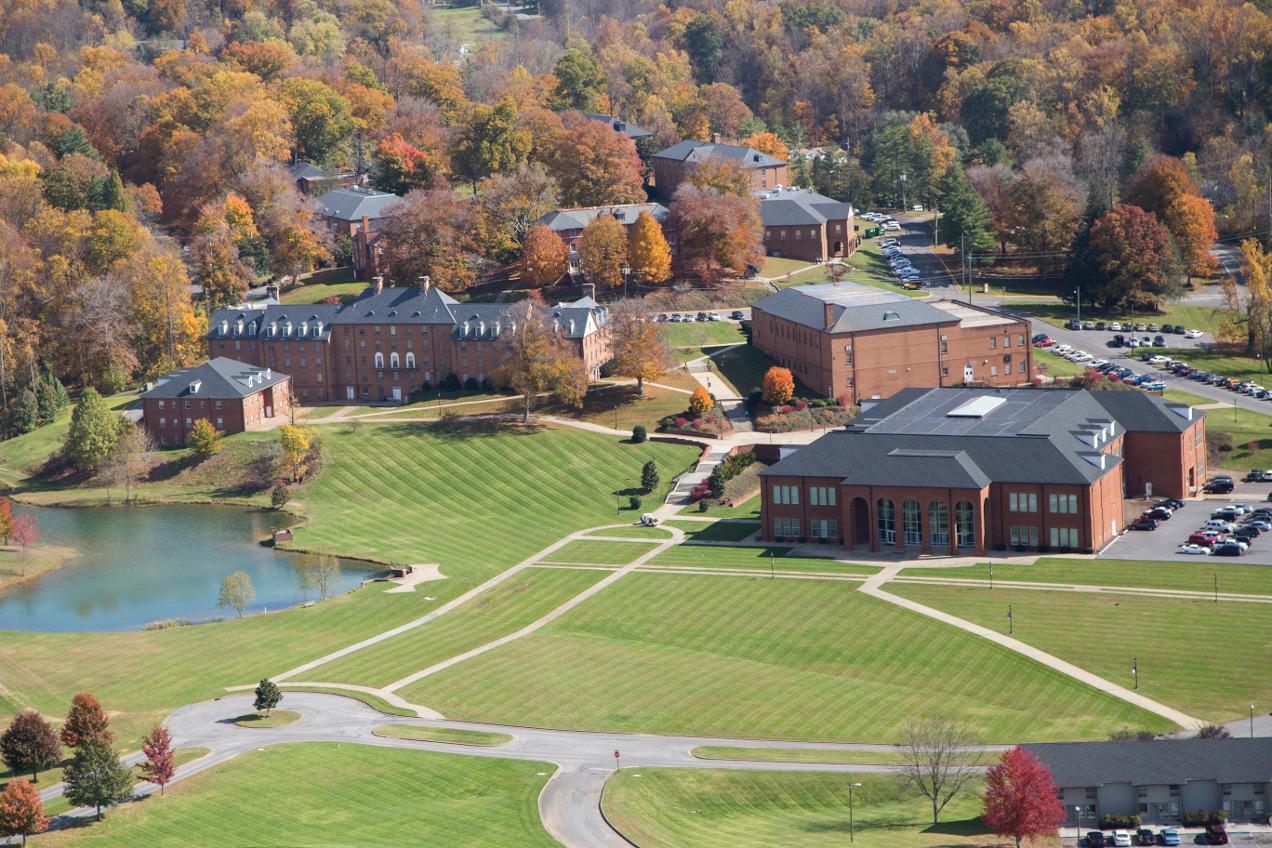
King University is a private, Presbyterian-affiliated university in Bristol, Tennessee, founded in 1867. It offers over 90 areas of study across five academic schools with a strong emphasis on faith, scholarship, and community. With a 12:1 student-faculty ratio and generous financial aid, King provides a personalised, values-driven education in the heart of the Appalachians.
Why study here
- Personalised learning with a 12:1 student-to-faculty ratio and faculty who are active mentors.
- Over 90 academic programmes including highly regarded nursing, business, and sport management degrees.
- 98% of students receive financial aid, with an average annual award of $20,336.
- Faith-informed community that fosters intellectual, social, and spiritual growth.
- Military Friendly Gold-status school with special support for veterans and military families.
Student life
King University offers a vibrant student life focused on fostering community, personal growth, and leadership. Students can participate in a wide range of activities, including dozens of clubs, intramural sports, and cheering on the King Tornado athletic teams (NCAA Division II). The university encourages community outreach, service projects, and mission trips. Residential students benefit from campus housing and shared facilities including the Dining Hall and recreation areas.
Fees
InternationalApprox. USD 27,000–29,000 per year (EUR 25,000–27,000) for undergraduate programs.
HomeApprox. USD 27,000 per year for domestic undergraduates.
LivingEstimated USD 10,000–12,000 per year for room, board, and personal expenses in Bristol, TN.
98% of students receive financial aid; average annual award is $20,336. Students are encouraged to complete the FAFSA.
Admissions
High School DiplomaAccredited secondary school diploma or equivalent (GED accepted).
GPAMinimum 2.5 GPA recommended for undergraduate admission.
English ProficiencyRequired for non-native English speakers; TOEFL or IELTS accepted.
TOEFL iBT61 minimum
IELTS Academic5.5 minimum
Rankings
Money MagazineBest College of America 2023
The New York Times Magazine#21 nationally for supporting mid-to-low-income students (2023)
Military Friendly®Gold-status school 2023
University scholarships
Anne Liston Endowed ScholarshipUp to USD 2,000
BlueCross Power of We Health Equity ScholarshipUSD 10,000
Evangelical Presbyterian Church (EPC) Foundation ScholarshipVaries
Accreditation
King University is accredited by the Southern Association of Colleges and Schools Commission on Colleges (SACSCOC). The nursing programme holds additional professional accreditation.
For international students
United StatesStudent visa & funds
International students primarily enter on the F-1 visa, which requires enrolment at a SEVP-certified institution. Before the visa interview the school issues a Form I-20 — a certificate of eligibility — for which a Designated School Official must verify documented funds covering tuition, living expenses and travel for the first year, plus a reliable source for subsequent years. The financial evidence must be specific and from an identified source.
Working while you study
F-1 students may work on campus up to 20 hours per week while classes are in session and full-time during official breaks, with no separate authorization needed. Off-campus work is generally not permitted in the first academic year. After one academic year in good standing, students may use Curricular Practical Training (CPT) for paid work that is an integral part of the curriculum, authorized by the school; other off-campus work requires an approved Employment Authorization Document from USCIS.
After you graduate
After completing a degree, F-1 students may apply for Optional Practical Training (OPT) — up to 12 months of work authorization in a related field — by filing Form I-765 and receiving an EAD before starting work. Graduates of a degree on the DHS STEM Designated Degree Program List may apply for a 24-month STEM OPT extension, for up to 36 months total. The extension requires an E-Verify employer and a qualifying STEM degree earned within the previous ten years.
English tests
- IELTSUG 6.0–6.5; PG 6.5–7.0; top-tier programs 7.0–7.5
- TOEFL iBTUG 80–100; PG 90–110; selective research universities 100+
- PTE AcademicUG 50–60; PG 55–70; highly selective programs 65+
Main intakes
AugustJanuary
Typical living cost
€1,420/month
Approximate all-in student budget; major cities run higher.
SourcesStudy in the States — Students and the Form I-20 · Study in the States — Financial ability · USCIS — Students and employment · USCIS — Optional Practical Training (OPT) for F-1 students · USCIS — STEM OPT extension · LeapScholar — Minimum IELTS scores for USA universities · Mastersportal — Student living costs in the USA (2025–2026)
Programs
a selectionKing University · United States
3+3 Accelerated Law Program
This program is a collaborative agreement between King University and Appalachian School of Law (ASL) that allows qualified students to complete their undergraduate degree and begin law school in an accelerated timeframe. Students will complete three years of undergraduate study at King University and then move on to Appalachian School of Law. Upon successful completion of their first year of law school, that year's coursework will retroactively count towards their undergraduate degree, effectively fulfilling the requirements for a bachelor's degree. This pathway is available for undergraduate majors in English, History, or Political Science.
Bachelor's
Level
—
Tuition
36 mo
Duration
King University · United States
Bachelor of Arts in Digital Media Art & Design (BA DMAD)
The Bachelor of Arts (BA) in Digital Media Art & Design (DMAD) at King University is designed to equip students with both the creative and technical skills necessary for visual communication in the digital age. This program transforms your passion for areas like digital photography, videography, and graphic design into a foundation for a career in the evolving digital media field. The curriculum emphasizes developing a strong portfolio through hands-on projects and provides a unique business component tailored for visual artists, preparing you to enter the industry or start your own ventures. You will learn to use industry-standard software and hardware in a supportive community, guided by expert faculty dedicated to your success.
Bachelor's
Level
—
Tuition
48 mo
Duration
King University · United States
Bachelor of Science in Nursing (BSN)
King University's Bachelor of Science in Nursing (BSN) program is designed for prelicensure students seeking a baccalaureate degree in nursing. The program emphasizes a holistic approach to patient care, fostering critical thinking, diversity, and social justice. You will develop essential skills through a combination of classroom learning and hands-on clinical experiences in various healthcare settings. The curriculum focuses on promoting health, spiritual well-being, and professional development, enabling you to build strong relationships with faculty and a diverse cohort of peers. Graduates are prepared for entry-level nursing roles and are eligible to sit for the NCLEX-RN licensure exam.
Bachelor's
Level
—
Tuition
48 mo
Duration
King University · United States
Education – Elementary Education (Grades K-5)
This Bachelor of Arts in Interdisciplinary Studies program, with a minor in Education and K-5 Licensure, is designed for students who aspire to teach in public elementary schools (Grades K-5). The program integrates degree and licensure requirements, allowing completion in four years for new students or two years for transfer students. It emphasizes small class sizes for enhanced faculty-student interaction, incorporates field experiences throughout the curriculum, and fosters strong connections with local school systems.
Bachelor's
Level
—
Tuition
48 mo
Duration
King University · United States
Education – Instructional Leadership Licensure Program
The fully online Instructional Leadership programs at King University are designed for current teachers who hold a teaching license and wish to pursue an administrative license or take on other leadership roles within their schools. The program emphasizes small class sizes, personal attention, and a flexible learning environment, with all classes conducted online in a synchronous format on Thursday evenings. King University provides built-in support for the School Leaders Licensure Assessment (SLLA), a key requirement for administrative positions. An option for a non-licensure track is also available, and the program includes a clinical field experience component for practical application of administrative best practices.
Master's
Level
—
Tuition
24 mo
Duration
King University · United States
Education – Secondary Education (Grades 6-12)
This program offers pathways to licensure for teaching in grades 6-12 and K-12 within Tennessee. To achieve licensure, students must complete an approved academic major with a licensure track, the education minor, and additional licensure requirements. The program emphasizes integrated field experiences, small class sizes for increased faculty interaction, and strong connections with local school systems. Some licensure areas are available in a fully online format.
Bachelor's
Level
—
Tuition
48 mo
Duration
Scholarships
for United States full funding
Duke University
Karsh International Scholarship Program
Open to international (non-U.S. citizen, non-permanent-resident) high school students applying for first-year undergraduate admission to Duke University. Candidates must demonstrate financial need through Duke's need-based aid process, show interdisciplinary academic curiosity, and have a record of community engagement. There is no separate scholarship form; international applicants who indicate they are applying for financial aid are automatically considered for the Karsh award.
full
Funding
€320k
Max
Jan 2, 2027
Deadline
 full funding
University of Miami (with the Stamps Family Charitable Foundation)
University of Miami Stamps Scholarship
Open to high school seniors, both domestic (U.S.) and international, applying for first-year undergraduate admission to the University of Miami through Early Decision I or Early Action. Applicants are automatically considered with no separate scholarship form; they must submit all first-year admission requirements and demonstrate strong academic achievement, leadership, and community involvement. Semi-finalists complete a Zoom interview.
full
Funding
€260k
Max
Nov 1, 2026
Deadline
 full funding
QuestBridge
QuestBridge National College Match Scholarship
Open to high-achieving US high school seniors from low-income backgrounds who are US citizens, permanent residents, or students studying in the US regardless of citizenship. Competitive applicants typically earn mostly A's in challenging courses, rank in the top 5-10% of their class, and have strong standardised test results (SAT/PSAT above 1310 or ACT above 28), though each application is read in context. Applicants must demonstrate strong writing, intellectual curiosity and determination through essays and recommendations. Matched students must attend a partner college as a binding-early-decision commitment.
full
Funding
€185k
Max
10d left
Deadline
full fundingArgonne National Laboratory
Maria Goeppert Mayer Fellowship at Argonne National Laboratory
Open to early-career scientists and engineers of all nationalities who hold a PhD awarded within the last three years at the time of application, or who will complete the PhD before the fellowship start date. Research interests must align with Argonne's mission areas. U.S. citizenship is required for national-security-related projects (Detection of Imaging Signatures).
full
Funding
€130k
Max
15d left
Deadline
 partial funding
Boustany Foundation / Harvard Business School
Boustany MBA Harvard Scholarship
Open to candidates of any nationality (priority to those of Lebanese descent) who have received an offer of admission to the Harvard MBA programme and have a strong academic background.
partial
Funding
€100k
Max
May 31, 2027
Deadline
 full funding
Stanford University
Knight-Hennessy Scholars
Open to citizens of any country who earned their first/bachelor's degree within the last ~7 years (or will by the Stanford start) and who apply for and gain admission to a full-time Stanford graduate program. Selection seeks independence of thought, purposeful leadership, and a civic mindset.
full
Funding
€90k
Max
22d left
Deadline
Frequently asked questions
What are the estimated annual fees for international undergraduate students at King University?
+
International undergraduate students can expect annual fees to range from approximately USD 27,000 to USD 29,000. This is equivalent to approximately EUR 25,000 to EUR 27,000 per year.
What is the student-to-faculty ratio at King University?
+
King University maintains a student-to-faculty ratio of 12:1. This ratio supports personalized learning experiences with faculty who are active mentors.
How much financial aid does King University offer?
+
King University offers generous financial aid, with 98% of students receiving financial aid. The average annual award is $20,336, making education more accessible.
What English proficiency scores are required for international students?
+
International students can demonstrate English proficiency with a minimum TOEFL iBT score of 61 or an IELTS Academic score of 5.5.
Where is King University located?
+
King University is located in Bristol, Tennessee, situated in the foothills of the Appalachian Mountains. Its campus is just two miles from downtown Bristol.
Last updated