SOUTH AFRICA · CAPE TOWN
University of Cape Town
public · Founded 1829 · Languages: en
In short
The University of Cape Town (UCT) is a leading research-intensive university in Africa, offering a diverse range of programs in a vibrant city. It provides robust student support and has a strong international outlook.
Key facts
- Type
- Public
- Founded
- 1829
- Students
- 23,500
- International students
- 4,500
- Acceptance rate
- 35%
- Tuition (intl)
- €4–7k/yr
- Languages
- EN
- Location
- Cape Town, South Africa
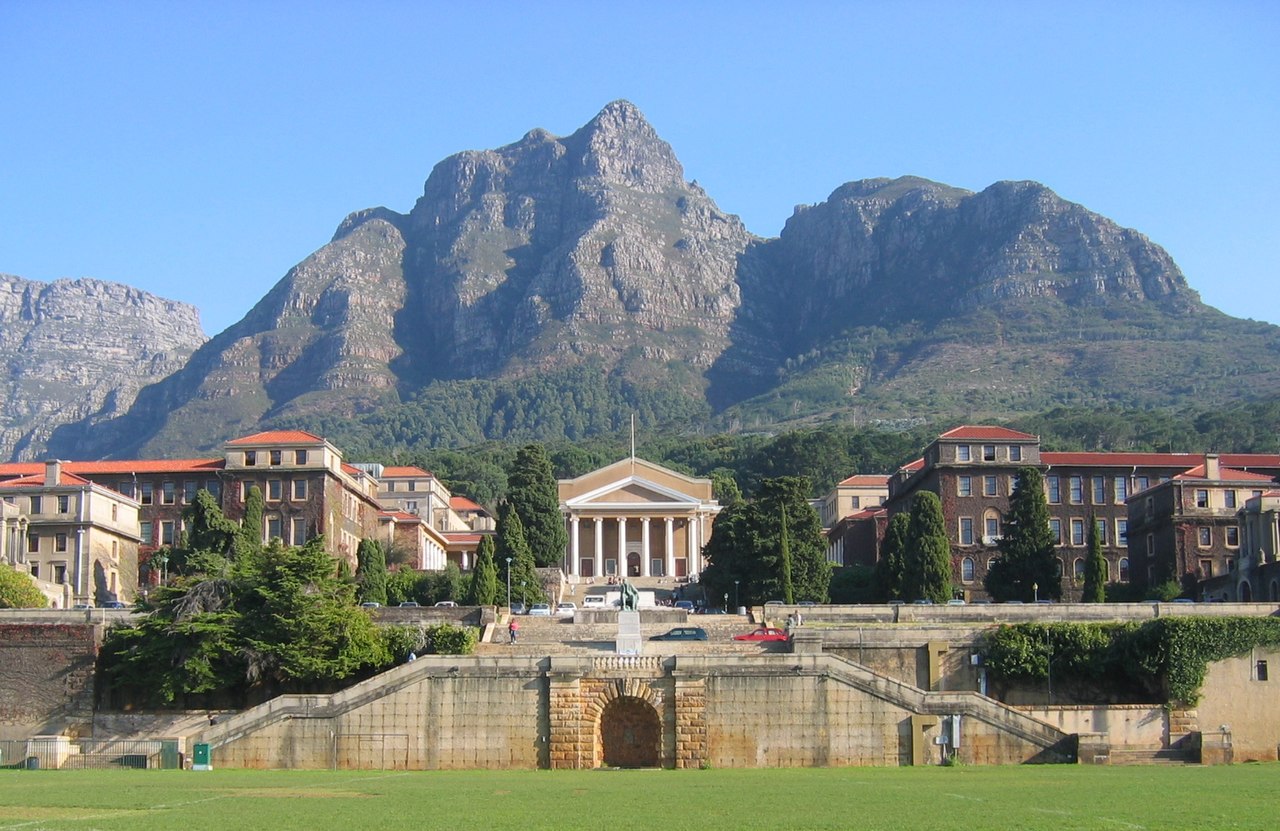
The University of Cape Town (UCT) is a leading research-intensive university in Africa, consistently ranked as the best on the continent. UCT is committed to addressing global and local challenges, with a strong focus on impactful research in areas like health, climate, poverty, and inequality. The university prides itself on its excellence, diversity, and resilience, aiming to shape the future through its Strategy 2030. UCT offers a wide range of undergraduate and postgraduate programs across six faculties, including Commerce, Engineering & the Built Environment, Health Sciences, Humanities, Law, and Science, as well as the Graduate School of Business (GSB) and the Hasso Plattner School of Design Thinking (d-school). The university provides state-of-the-art facilities, extensive academic and peer support, and vibrant research networks to foster student success. Situated in Cape Town, a historically diverse and iconic city, UCT provides an enriching academic and personal experience. The university offers various services to support students, including comprehensive transport options and strong safety measures, to help them navigate campus life and the city.
Why study here
- Access a world-class university education with qualifications that are internationally recognised and locally applicable.
- Benefit from comprehensive support systems, including academic and peer mentoring, cultural and transition support, and career guidance.
- Engage with cutting-edge research addressing critical global issues such as climate change, poverty, inequality, and public health.
- Connect to extensive research, networking, and career-building opportunities through global partnerships across Africa and worldwide.
- Be part of a leading African institution with a commitment to ethical leadership, social justice, and making a positive impact on home communities.
Student life
Life at UCT extends beyond academics into the vibrant city of Cape Town. The university provides various support services to help students integrate and make the most of their experience. Getting around campus is primarily done by walking or cycling. UCT offers a free shuttle service (Jammie Shuttle) that transports students between campuses and other parts of the city seven days a week. Public transport options like MyCiTi buses, Metrorail trains, Golden Arrow Bus Services, and ride-sharing apps (Uber) are also available. Student safety is a priority, with extensive Campus Protection Services on hand. The university assists with accommodation searches, offering guidance on on-campus housing and private rentals.
Fees
InternationalInternational students' fees depend on their citizenship/residency status. Students from SADC countries pay tuition fees, a SADC Administration Fee, and any applicable residence fees. International students from non-SADC countries pay tuition fees, an International Administration Fee, an International Term Fee (for coursework qualifications only), and any applicable residence fees. Refugees and asylum seekers recognized by the South African Department of Home Affairs pay the same fees as South African students.
Home—
LivingEstimated annual living costs in Cape Town for international students range from roughly ZAR 90,000 to ZAR 150,000, covering accommodation, food, transport and personal expenses. Costs vary with accommodation choice and lifestyle.
Fee schedules are typically published at the end of the previous year. Students can use an online pro-forma invoice to calculate fees. Your fee status is determined at application based on citizenship documents, but can be reviewed by the International Office upon presentation of alternative proof of citizenship.
Admissions
Undergraduate Application Deadline31 July
Postgraduate Application Deadline30 September
Fine Art Portfolio Submission Deadline31 August 2025 (for 2026 study)
Fine Art Central Admissions Application Deadline31 July 2025 (for 2026 study)
IELTS AcademicOverall 7.0 is typically required for most programmes; some faculties accept 6.5.
TOEFL iBTOverall 90+ typically required; check faculty-specific requirements.
Rankings
Times Higher Education (THE) World University Rankings 2026=164th in the world
Quacquarelli Symonds (QS) World University Rankings 2025150th in the world
US News & World Report Best Global Universities Rankings 2025–2026=124th in the world
Center for World University Rankings (CWUR) 2025275th in the world
ShanghaiRanking’s Academic Ranking of World Universities 2025201–300 in the world
Quacquarelli Symonds World University Rankings: Sustainability 2026=59 in the world
THE Reputation Rankings 2022176–200 range
THE Most international universities in the World Rankings 2025=60th in the world
Financial Times Executive MBA rankings 202453rd in the world
THE Impact Rankings 2025 (Overall)101-200
ShanghaiRanking’s Global Ranking of Sport Science Schools and Departments 202510th in the world (Sport Science)
QS World University Rankings by Subject 2025=15th in the world (Development Studies)
US News & World Report Best Global Universities Rankings for Subjects 2025-202628th in the world (Infectious Diseases)
ShanghaiRanking’s Global Ranking of Academic Subjects 202547th in the world (Geography)
ShanghaiRanking’s Global Ranking of Academic Subjects 202549th in the world (Public Health)
University scholarships
Mastercard Foundation Scholars ProgramFull-cost scholarship
Accreditation
UCT's Office of Research Integrity (ORI) ensures that all research is conducted responsibly and ethically, aligning with UCT’s Policy for the Responsible Conduct of Research. The ORI provides online learning modules, webinars, seminars, and direct guidance to postgraduate students on topics such as research misconduct, responsible authorship, human research data management, and research ethics.
Programs
a selectionUniversity of Cape Town · South Africa
Bachelor of Business Science specialising in Economics
Bachelor's
Level
—
Tuition
—
Duration
University of Cape Town · South Africa
Bachelor of Science (BSc) Major in Physics
The University of Cape Town's Department of Physics offers a comprehensive Bachelor of Science (BSc) major in Physics. This three-year program provides a strong foundation in the fundamental principles of physics, covering a wide range of topics essential for understanding the physical world. Graduates will be equipped with analytical and problem-solving skills applicable in various scientific and technological fields.
Bachelor's
Level
—
Tuition
36 mo
Duration
University of Cape Town · South Africa
Bachelor of Social Science Degree Majoring in Economics
Bachelor's
Level
—
Tuition
—
Duration
University of Cape Town · South Africa
BCom Honours in Economic Analysis of Financial Markets
This Bachelor of Commerce Honours programme focuses on the Economic Analysis of Financial Markets, designed to equip you with the skills needed for a successful career in the financial sector. You will gain a strong understanding of economic principles applied to finance, learn to analyse and interpret financial statements, and master quantitative methods for financial decision-making. The programme prepares you to analyse complex financial situations, utilize advanced economic modelling and econometrics, and develop financial strategies by bridging different disciplines.
Bachelor's
Level
—
Tuition
18 mo
Duration
University of Cape Town · South Africa
BCom Honours in Economics
The BCom Honours in Economics is a one-year, full-time programme designed for graduates with a strong interest in economics who wish to deepen their understanding and refine their skills for research and professional careers. The programme begins in January. The first semester focuses on core economic theory and empirical techniques, while the second semester allows students to apply these concepts through a range of elective specialisations. You will be taught by experienced faculty members who are also involved in the policy environment.
Master's
Level
—
Tuition
12 mo
Duration
University of Cape Town · South Africa
BCom in Economics and Finance
The Bachelor of Commerce (BCom) in Economics and Finance at the University of Cape Town provides a solid foundation in economic principles and equips students with the skills needed to understand and operate in the financial world. This program delves into both microeconomic topics, such as firm behavior and profit maximization, and macroeconomic issues, including unemployment, inflation, and economic growth. Students will develop a deep understanding of economic policy challenges and the complexities of economic crises. This analytical ability is highly valued by employers, particularly in fields like asset management, stock-broking, merchant banking, investment guidance, and management consulting. A background in economics signals strong analytical thinking capabilities, making graduates attractive for further training and career development.
Bachelor's
Level
—
Tuition
36 mo
Duration
Scholarships
for South Africa full funding
Accenture Education Trust Fund
Accenture Education Trust Scholarship
Open to South African citizens from low-income households (parents/guardian earnings under R1 million) with a strong academic record who are enrolled full-time at a selected tertiary institution in South Africa.
full
Funding
€9k
Max
15d left
Deadline
 full funding
University of Pretoria
University of Pretoria Commonwealth PhD Scholarship
Open to citizens of Commonwealth countries (excluding South Africa) who hold a master's degree completed at least two years before applying and are under 38 years of age at the time of application. Applicants must not be current or former master's or doctoral students at the University of Pretoria. The award funds full doctoral study at UP with tuition coverage, a living allowance, and research support.
full
Funding
€0k
Max
5d left
Deadline
full fundingThe Mandela Rhodes Foundation
Mandela Rhodes Scholarship
African nationals aged ~19–30 with a strong academic record (~70%+ average) pursuing an honours or master’s degree at a South African university, showing leadership and a commitment to Africa’s development.
full
Funding
—
Max
Apr 30, 2027
Deadline
 full funding
Wellcome Trust
Wellcome Trust Fellowships and Grants (for international researchers)
For researchers at different career stages working on health-related science. Wellcome funds a family of fellowships and grants — early-career, career-development, and discovery awards, plus team and translational funding — each with its own eligibility, value, and call deadline. There is no single scholarship application; you apply to the specific scheme that fits your stage and project.
full
Funding
€3000k
Max
Rolling
Deadline
 full funding
Wellcome Trust
Wellcome International Training Fellowships
For early-career researchers based in low- and middle-income countries (outside the high-income world) who want protected time and support for research training in health, often including a PhD or postdoctoral research. Wellcome's scheme names and exact criteria change over time, so applicants should check the current relevant Wellcome funding scheme.
full
Funding
€150k
Max
Rolling
Deadline
 full funding
European Commission - European Research Executive Agency (REA)
Marie Sklodowska-Curie Actions Postdoctoral Fellowships
Open to researchers of any nationality who hold a PhD (or will have defended their doctoral thesis by the call deadline) and have at most 8 years of full-time-equivalent research experience after the PhD. Applicants apply jointly with a host organisation - a university, research institution, business, SME, or other body based in an EU Member State or a country associated to Horizon Europe. European Postdoctoral Fellowships are open to all nationalities for a project inside the EU or an associated country; Global Postdoctoral Fellowships are reserved for EU nationals or long-term residents who carry out a phase in a third country before returning to Europe. Researchers who have been displaced by conflict and those restarting a research career after a break are explicitly encouraged to apply.
full
Funding
€100k
Max
-5d left
Deadline
Frequently asked questions
What are the general rankings of the University of Cape Town?
+
The University of Cape Town is consistently ranked among the top universities globally. Recent rankings include 164th in the world by Times Higher Education (THE) World University Rankings 2026 and 150th by Quacquarelli Symonds (QS) World University Rankings 2025.
What academic programs are offered at the University of Cape Town?
+
UCT offers a wide array of undergraduate and postgraduate programs across six faculties: Commerce, Engineering & the Built Environment, Health Sciences, Humanities, Law, and Science. It also includes the Graduate School of Business (GSB) and the Hasso Plattner School of Design Thinking (d-school).
What are the estimated living costs for international students in Cape Town?
+
Estimated annual living costs for international students in Cape Town range from approximately ZAR 90,000 to ZAR 150,000. This estimate covers accommodation, food, transportation, and personal expenses, with variations based on lifestyle and accommodation choices.
What are the English language proficiency requirements for international students?
+
For most programs, an IELTS Academic score of 7.0 overall is required, though some faculties may accept 6.5. Alternatively, a TOEFL iBT score of 90+ overall is typically expected, but it's advisable to check specific faculty requirements.
What support services are available for international students at UCT?
+
UCT provides comprehensive support including academic and peer mentoring, cultural and transition support, and career guidance. The university also offers services like the Jammie Shuttle for transportation and assistance with accommodation searches.
Last updated